Specialised apps, new training drills: Forming an Indian badminton doubles style
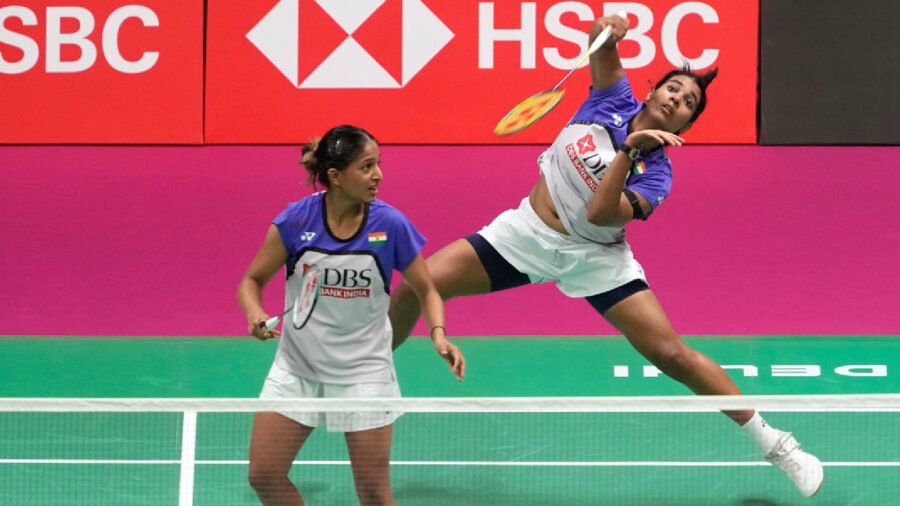
‘Korean defence’ is a full-fledged drill that entire training sessions at Hyderabad’s Pullela Gopichand badminton academy are devoted to, in recent years. It’s fast-paced, low-crouched relentless extending of a rally in which hypnotic shuttle exchanges both unlock and unleash reflexes – for that’s the Operating System of doubles: speed, laced with power.
While Taufuk Hidayat, Lin Dan, Lee Chong Wei, Lee Hyun-Il and Tai Tzu-ying were emulated for their game styles as singles legends, Korean doubles stalwart Lee Yong Dae and current World champs, Baek Ha Na and Lee So-hee, have been the gold standard in terms of footwork, stance, rhythm and racquet angles. Three of India’s last six World Championship medals have come in doubles, and it reflects in the training lingo, the buzzwords, catchphrases and the actual court drills and off-court habits that are slowly ushering in a doubles culture.
Even the applications downloaded on phones are geared towards improving reflexes and mental agility needed in doubles.
Story continues below this ad
Treesa Jolly and Gayatri Gopichand kept India’s World Championships streak going with a bronze in Delhi, after taking out World Nos. 7 and 4 pairings on the way. But it’s Satwiksairaj Rankireddy and Chirag Shetty who deserve a lion’s share of the credit in placing doubles front and centre for completing a decade together with multiple achievements.
But with women’s doubles also scoring its second Worlds medal for India now, the vocabulary and the lens with which it got viewed is changing quickly. Badminton’s next generation has arrived, and it speaks ‘Doubles’.
On an average training day, it won’t merely be the crowded court with 4-6 players engaged in fast exchanges, hooting, whistling and bantering about as doubles courts tend to be. Doubles shuttlers now have their eyes trained, with colour cones at four corners serving as cues for which shot to play and where on a verbal prompt. In another colour-coded drill, two different coloured shuttles are fed at fast clip with players required to play either attacking counter-drives and pushes or soft drops and cross-court blocks depending on the colour of the shuttle.
Spending nearly two months’ training only on net dribbles might’ve sounded like an unconventional way to prepare for a World Championships, but much of the doubles coaching work going on at Hyderabad, in developing an ‘Indian style’, relies on Indian smarts and good hand skills to break down a rally while keeping pace with the East Asian speed on the flat drive game.
Story continues below this ad
So while the Korean style works on transitions from defence to offence with racquets redirecting the shuttle, India’s top mixed doubles shuttler Tanisha Crasto adds that they are using tennis balls bouncing off walls and ground for plain reflex-activations.
BlazePods or digital reaction lights are deployed where during a flat-drive or mid-court monotone passage of play, the players have to stay alert to randomly flashing lights of their designated colour. This increases peripheral alertness because so much is happening in a doubles game at the same time.
“Building reflexes and reducing reaction times is the goal. We all have different games, but I use the ‘One Brain’ app on my phone for reflex training,” Tanisha says.
Changing culture
Doubles often faces the problem of Indian parents pushing their wards towards singles because they don’t want to deal with partnership hassles. So while increasing depth after trusting coaches and stepping back is just the first step, the real doubles struggle starts after committing to a partner.
Story continues below this ad
“The serve-and-receive is totally different from singles,” coach Sumeeth Reddy explains. The assortment of wicked serves – tumble, straight-fast, legal-spin and flick – get deservedly disproportionate time as coach Gopichand ominously says,
“You will see a bunch of Indians honing those serves and using them.”
The drives-game (flat parallels) is something that’s not seen in singles, but is on the menu in doubles. Attack-defence also means two vastly different things in doubles than singles.
“In singles, you are looking for gaps. Doubles is not about finding gaps,” Sumeeth says. “It’s about sensing which opponent is slow or tentative on the day, and targeting them with the right attack.”
Story continues below this ad
The nature of the nemesis has undergone a change too. The training courts in Hyderabad that a decade ago were devoted to solving the Yihan Wang-puzzle for Saina-Sindhu, now have Liu Shengshu and Tan Ning on their dartboard.
“It’s not good when you lose to them,” Treesa says, adding every loss has given the Indians enough arsenal to strike the next time, but deciphering the Tan tumble-serve and devising counters will happen in training.
“It’s a matter of time. We just need to believe we can beat those players,” she says of the 1-7 head-to-head against the dominant World No 1s, who won silver in Delhi.
Story continues below this ad
“We both are here to do something big,” Treesa says of what drives her and Gayatri, a pairing that many clamoured to split up and disregard before the bronze.
Five of the last six World Championships medals for India have now come from the Hyderabad training base; three in doubles. India’s doubles DNA is commensurately changing.
India win second gold medal of Asian Games: Suruchi, Kamaljeet storm to mixed team title
By Sohail Khan · 25 Sep
A passage to India and other international stories
By Sohail Khan · 25 Sep