Simultaneous polls possible in 2029, says panel chief
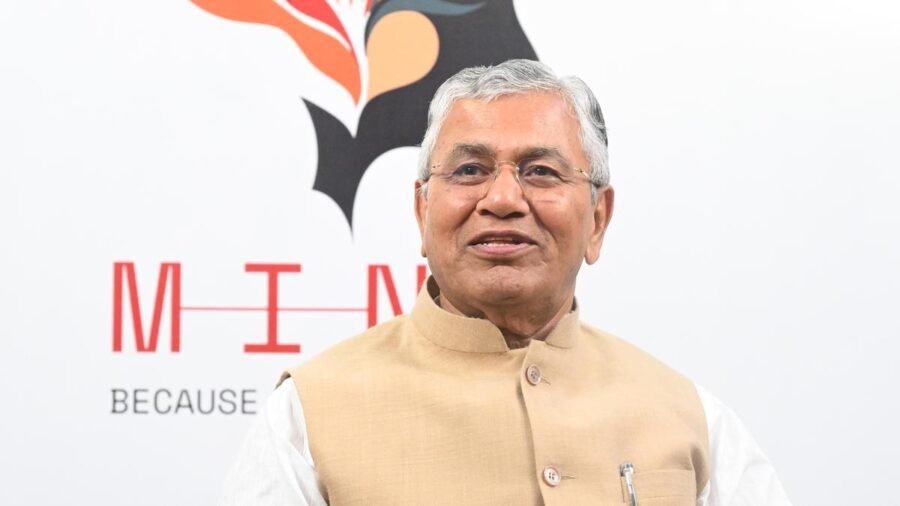
Holding simultaneous elections for the Lok Sabha and State Assemblies in 2029 under the Modi government's ‘One Nation, One Election’ initiative is possible if the Constitution is amended and state governments support the move, according to P.P. Chaudhary, the chairman of the joint parliamentary panel examining the related bills.
The Constitution (129th Amendment) Bill, 2024, and the Union Territories Laws (Amendment) Bill, 2024, which aim to synchronise Lok Sabha and State Assembly polls, were sent to the 31-member joint committee of Parliament headed by Mr. Chaudhary, a BJP MP from Rajasthan, following the Opposition's demand for broader scrutiny.
When asked if State assembly elections could be held alongside the 2029 Lok Sabha polls, Mr. Chaudhary said on Monday (August 24, 2026) that if the constitutional amendment is approved in Parliament by 2028, the rollout of ‘One Nation, One Election’ can begin that same year.
"Then what is the problem? If the States express their desire in 2029, we can't give the States directions to dissolve their Assembly.”
"They have to make their own decisions. It depends on the respective Chief Ministers and their Council of Ministers. If the Council of Ministers of the States decide in favour of ‘One Nation One Election’, that State elections should be held along with the Lok Sabha polls, then it is possible. It is up to them what they decide. The Indian Constitution allows that; it is permissible.”
"Under the Indian Constitution, the states are empowered to hold simultaneous polls," he told reporters at the Parliament House complex after a meeting of the panel.
The BJP leader said democracy means the will of the people, not the will of the political parties, and everyone has to see what the will of the people is.
"We have visited 10 states and interacted with a cross-section of people, and we have realised that 99 per cent of people, civil society, want simultaneous polls for Lok Sabha and State Mssemblies," he said.
Mr. Chaudhary said there may be different opinions of political parties, but the committee has to work together in the interest of the country.
"We have to work on what the people want, what the country wants. We are working with the will of the people. That is why we have invited civil society members to take their opinions," he said.
Mr. Chaudhary said that Parliament gave the panel the mandate to examine and give recommendations on the two Constitution amendment bills.
Two-thirds of members of Parliament have to support the bills for their passage.
Another government-sponsored Constitution amendment bill, the delimitation-linked women reservation bill, which also required support of two-thirds of members of Parliament, was defeated in the Lok Sabha in April.
Mr. Chaudhary said the Parliament mandated the committee to examine the legislation and fix the shortcomings, if any, and make sure that the simultaneous polls are held successfully.
He said if simultaneous elections in Lok Sabha and State assemblies are held, everyone will benefit from it and the biggest beneficiary will be the country's youth.
mr. Chaudhary also said that 30% of the time of government schools is used in poll-related work every year.
The Bills were introduced in the Lok Sabha in December 2024, following which they were referred to the joint committee for examination.
The Bills were formulated after a high-level panel, headed by former President Ram Nath Kovind, recommended holding Lok Sabha, State assembly and local body elections simultaneously in a phased manner. Union Home Minister Amit Shah was also a member of the high-level panel headed by Mr. Kovind.
Following the adoption of the Constitution, elections to the Lok Sabha and all State Legislative Assemblies were conducted simultaneously from 1951 to 1967.
The first general elections to the Lok Sabha and State Assemblies were held together in 1951-52, a practice that continued for three subsequent general elections in 1957, 1962, and 1967.
However, this cycle of synchronised elections was disrupted in 1968 and 1969 due to the premature dissolution of some State Legislative Assemblies.
The Fourth Lok Sabha was also dissolved prematurely in 1970, with fresh elections held in 1971. Unlike the First, Second, and Third Lok Sabha, which completed their full five-year terms, the Fifth Lok Sabha's term was extended until 1977 under Article 352 because of the declaration of Emergency.
Since then, only a few Lok Sabha terms have lasted the full five years, such as the Eighth, Tenth, Fourteenth, and Fifteenth. Others, including the Sixth, Seventh, Ninth, Eleventh, Twelfth, and Thirteenth, were dissolved early.
State Assemblies have faced similar disruptions over the years. Premature dissolutions and term extensions have become a recurring challenge.
These developments have firmly disrupted the cycle of simultaneous elections, leading to the current pattern of staggered electoral schedules across the country.
Muttil tree-felling case: Keralam Forest dept. resubmits chargesheet after correcting errors
By Sohail Khan · 25 SepKarnataka hikes PG course fees in government first-grade colleges by 10% for 2027-28
By Sohail Khan · 25 Sep
Keralam govt. forms five-member panel for land reforms
By Sohail Khan · 25 Sep