Rishabh Pant’s century of sixes came faster than anyone in Test history
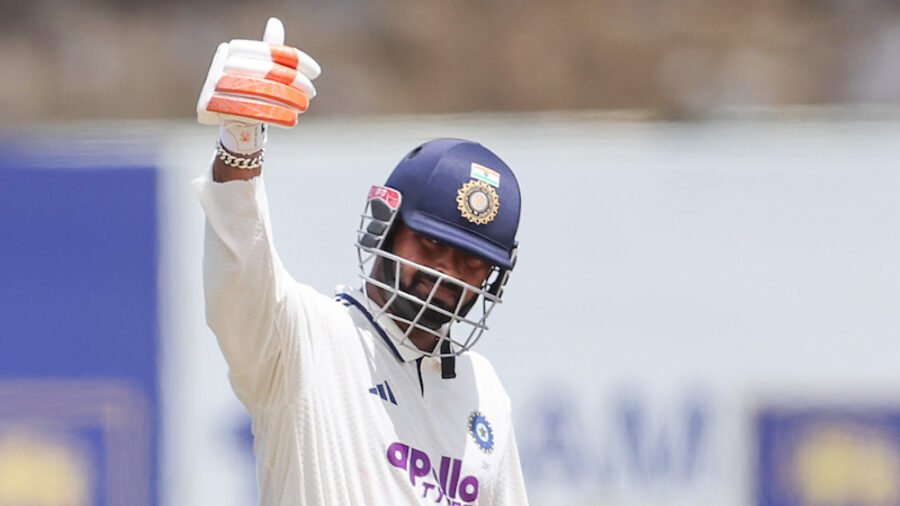
There are glorious Test careers that pass with nominal numbers in the six column. Australia opener David Boon, at odds with the machismo of his bristling moustache and piercing eyes, struck only two sixes in 18,116 balls. English opener Mike Atherton, no less obdurate, managed only four off the 20,609 deliveries he soaked up in Test cricket. VVS Laxman, disinclined to the savage pleasure of hitting sixes, brush-stroked only five balls beyond the fence.
Unlike in the shorter formats, it isn’t a handicap or an anomaly there, but a number largely irrelevant to the game. Ben Stokes, the leading six-hitter in the long form, is remembered for his nerveless heists; the six-hitting prowess is merely an embellishment. Even Viv Richards, prophet of the most brutal swipes, is deified less for his sixes than for his swaggering aura. The six is not a requisite. It is, largely, dispensable.
The premise of the six in this format is what makes Rishabh Pant’s feat, a century of sixes, the quickest ever, all the more striking. He has built a career out of a Test batsman’s most dispensable run-scoring option. He needed only 4,934 balls for his hundred sixes, one every 49 balls. Stokes’s 138, a record now at the mercy of Pant, came at one every 90 balls. Second on the list is Brendon McCullum, whose 107 arrived at one every 93rd ball. Adam Gilchrist, the first to reach a hundred, completes the quartet, a list without room for fearsome six-hitters like Chris Gayle, Virender Sehwag and Rohit Sharma. It’s a curiously absorbing list: Jacques Kallis, cricket’s perceived stonewaller, has hit more sixes (97) than Brian Lara (88), Sachin Tendulkar (69), AB de Villiers (64) and Ricky Ponting (73), the entertainers of his own era.
20th Test fifty, Rishabh Pant brings it up with a six! 🔥
— Sony Sports Network (@SonySportsNetwk) August 18, 2026
The achievement won’t be romanticised the way Don Bradman’s 99.94 is, or Brian Lara’s 400, or Sachin Tendulkar’s 51 hundreds. Nor will it stand as a metaphor for T20 cricket’s pull on the Test game (even after the Bazball boom, a six still arrives only once every 155 balls), or suddenly make the six the strongest currency in the sport. It exists instead as an exotic outlier, worth fishing up to celebrate the quirks that make Pant such an unputdownable watch, and such an improbable success in red-ball cricket.
A six is his method. It’s his madness too. He plays perfectly crisp strokes along the ground; he unfurls scything cuts, drills bullet cover-drives, whips through flicks. That’s often his intention, until the bowler bristles in his run-up and the blood rushes in Pant’s veins. That’s when instinct overrides instructed wisdom, unbothered by the situation, his own form, or the sniff of a milestone. So instinctive is his six-hitting that he struggles to break it down for an audience. “If the ball is there to hit, I’ll hit it. You have to punish it, that’s what I’m doing,” he once said.
It’s as natural to him as a cover drive was to Virat Kohli, or a flick to Mohammed Azharuddin, or the front-foot defence, ripped straight off the stylesheet, was to Rahul Dravid. It’s an expression of his joy, of the way he plays the game and feels it too. The record may well be a byproduct of his aggression rather than something he ever set out to chase. But the six is his métier. It isn’t merely a tool to disrupt a bowler’s length, a ploy to deny him rhythm. It’s the stream his runs flow through. Sixes account for 600 of his 3,557 runs, nearly one-sixth of everything he’s scored.
Rishabh Pant stepped out and sent that one straight into the Galle skyline. 🚀
— Sony Sports Network (@SonySportsNetwk) August 18, 2026
A Pant six is riveting theatre. It’s unpredictable: he might hit the first ball of an innings for six, even if the situation screams for caution. It subverts logic: he takes on the fiercest bowlers, reverse-sweeping James Anderson among them. It borders on absurd: one-handed, upper body flailing, knees buckled, his whole frame tumbling in the follow-through. It finds corners captains struggle to set a field for. The technique itself fascinates: the balance, the stillness even in motion, the free-flowing swing, the extraordinary reach for a man of his height, the loose bottom hand, the hand-eye coordination, bat-swing taking precedence over raw bat-speed.
The six carries his ambition and his desire. But more than either, it carries the free-spiritedness that defines the way he plays. It’s his method, and his madness.

Chess Olympiad: Israel forfeit Rd 6 match after Netherlands, Bulgaria refuse to reschedule
By Sohail Khan · 21 Sep

Asian Games: Indian Rowers threaten to go on ‘strike’ after last-minute crew changes
By Sohail Khan · 21 Sep