Recalling Harchand Singh Longowal, a moderate voice during Punjab’s turbulent times
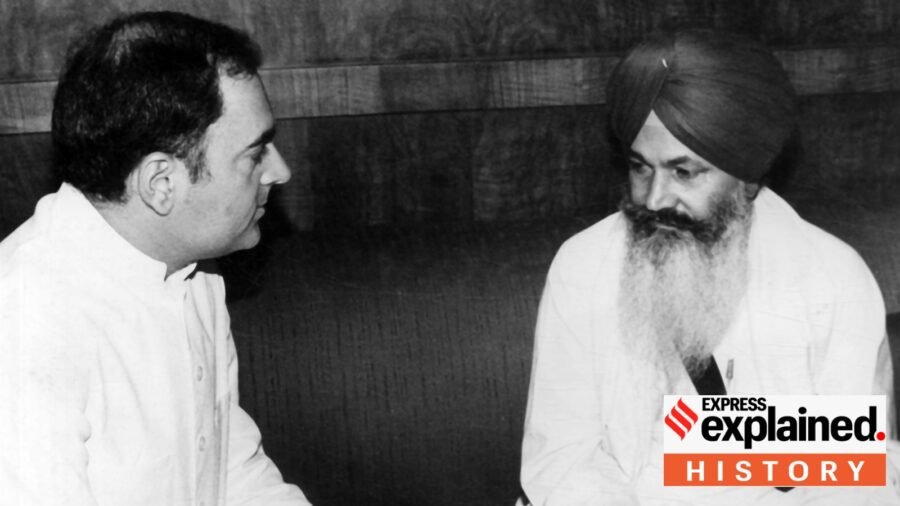
August 20 marks the 41st death anniversary of Sant Harchand Singh Longowal, one of the most prominent Sikh political figures during Punjab’s turbulent 1970s and 1980s.
Longowal, who was the chief of the Shiromani Akali Dal (SAD), was a moderate political face of the Akali movement at a time of insurgency. He was assassinated in 1985, less than a month after signing the Punjab Accord with then prime minister Rajiv Gandhi.
This year, a tussle has broken out between the SAD (Badal) and its breakaway faction, SAD (Punarsurjit), over the venue of his death anniversary programme in Longowal village. Beyond the immediate controversy, here’s a look at Longowal’s life and death.
Who was Harchand Singh Longowal?
Harchand Singh Longowal, popularly known as Sant Harchand Singh Longowal, was born on January 2, 1932, in Gidariani village of Sangrur district, then in the princely Patiala State.
From a young age, he was inclined towards religion and studied Sikh scriptures and kirtan under Sant Jodh Singh. The “Longowal” in his name refers to the village in Sangrur he came to as a young religious preacher and later made his permanent base. The ‘Sant”, of course, reflected his religious life and standing as a preacher.
Preaching to politics
Longowal gradually became involved in the Akali movement — which sought greater political and religious rights for Sikhs — and politics in the mid-1960s.
In the 1969 Punjab Assembly election, he defeated Congress heavyweight Babu Brish Bhan, who had served as chief minister of Patiala and East Punjab States Union (PEPSU), from Lehra constituency in Sangrur.
Story continues below this ad
His stature increased considerably during the Emergency imposed by then prime minister Indira Gandhi in 1975. When senior Akali leaders decided to court arrest in protest against the suspension of civil liberties, Longowal emerged as one of the principal leaders of the agitation.
In 1980, when the SAD was deeply divided into different factions, Longowal was elected its president. He was re-elected the following year too.
Under his leadership, the Akali Dal launched agitations against the Centre over Punjab’s political, economic and religious demands. These included the demand for the transfer of Chandigarh to Punjab, resolution of the river-water dispute and implementation of the Anandpur Sahib Resolution seeking greater autonomy for the state.
On August 4, 1982, he launched the Dharam Yudh Morcha — a united front against the government in Delhi.
Story continues below this ad
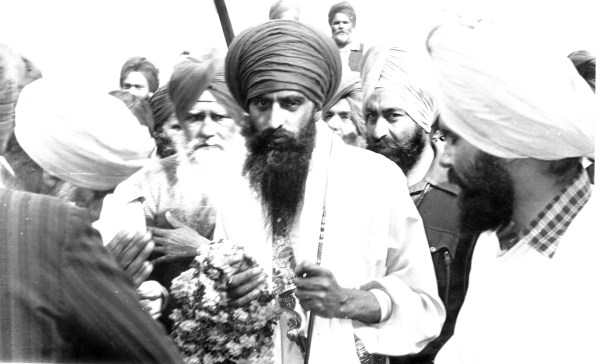 Jarnail Singh Bhindranwale. Express archive
Among those who joined the morcha was Jarnail Singh Bhindranwale, who later shifted his operations to the Akal Takht complex in the Golden Temple to avoid capture. The two would soon fall apart owing to ideological differences.
The 1982 Asian Games protest
The Asian Games were to be held in Delhi from November 19, 1982. Longowal announced that Akali volunteers would go to Delhi and court arrest during the games to draw national and international attention to their demands.
Fearing disruption, the Centre and the Haryana government sealed the approaches from Punjab to Delhi, putting up roadblocks and checkpoints and stopping and searching vehicles and trains carrying Sikh travellers. The restrictions became a major grievance, particularly because Sikh passengers, including army personnel and ex-servicemen, were subjected to special checking.
The crackdown came against the backdrop of a much larger civil disobedience campaign. Thousands had been arrested in the first 88 days of the Dharam Yudh Morcha, with at least 2,500 Sikhs kept in preventive detention until after the Asian Games.
Story continues below this ad
The aftermath was politically significant. Although the Akalis did not disrupt the Asian Games, the sealing of borders and treatment of Sikh travellers deepened resentment and strengthened the Akali mobilisation. The agitation subsequently intensified through programmes such as Rasta Roko in January 1983, Rail Roko in June and Kam Roko in August 1983. Ultimately, the Dharam Yudh Morcha continued for a few more months till mid-1984.
Longowal’s moderate face
In June 1984, the Centre launched Operation Blue Star to flush out Sikh militants, including Bhindranwale, who were holed up inside the Golden Temple complex. The operation ended with the death of Bhindranwale but its ripples were deep — it led to the assassination of prime minister Indira Gandhi by her Sikh bodyguards, which, in turn, triggered some of the worst communal violence ever witnessed in India, as Sikhs were openly targeted and killed.
During the time of Blue Star, Longowal, along with other senior Akali leaders, was also inside the complex. He was detained for about nine months before being released on March 12, 1985 as a result of the Rajiv Gandhi government withdrawing its detention orders against him and other senior Akali leaders.
The reason was that the government wanted to reopen political dialogue with the Akali leadership in the aftermath of the violence. On July 24 of that year, Longowal went on to sign the Punjab Accord — also known as the Rajiv-Longowal accord. It focused on the transfer of Chandigarh to Punjab, the rehabilitation of Sikh deserters from the Army, and compensation to the victims of 1984 riots.
Story continues below this ad
This, then, was Longowal’s importance — a moderate face of the Akali movement that the government could speak with. Soon after the accord, however, protests broke out in Haryana over the Chandigarh issue. Even within Punjab, a large section of the Akali leadership was against this accord.
Less than a month after the signing, however, Longowal was gunned down by militants Jarnail Singh Halvara and Gyan Singh Leel in Sherpur village of Sangrur district on August 20, 1985. The date happened to be Rajiv Gandhi’s birthday. Longowal was 53 at the time and had never married.
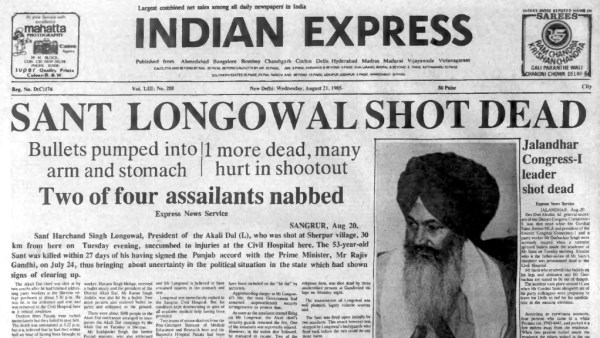 front page report on Longowal’s killing.
Later, his disciple Gobind Singh Longowal rose to be the SGPC president and MLA of Dhuri constituency in Sangrur. Gobind Singh Longowal is now part of the breakaway SAD (Punarsurjit).
Longowal’s ‘barsi’ row
Longowal’s ‘barsi’ is observed annually by the SAD, Congress and AAP. For the past three-four years, breakaway SAD factions have also held separate programmes in Longowal village. This year’s controversy erupted after the Sangrur administration allotted different parts of the Longowal grain market to SAD (Punarsurjit) and the Sukhbir Singh Badal-led SAD.
Story continues below this ad
Punarsurjit was given the shed area, while the Badal faction got the open, cemented area. The Badal-led SAD approached the Punjab and Haryana High Court but eventually shifted its programme to Bhai Mani Singh Khalsa College, where it has held its conference for the past two years.
State governments have traditionally declared a local holiday in Sangrur and Barnala districts on Longowal’s barsi.

Samantha Ruth Prabhu’s pregnancy coffee raises a question: How much caffeine is safe?
By Sohail Khan · 22 Sep
6 lessons from a public audit of the SIR in Delhi
By Sohail Khan · 22 Sep
AI experts warn against ‘apocalyptic’ rhetoric on risks
By Sohail Khan · 22 Sep