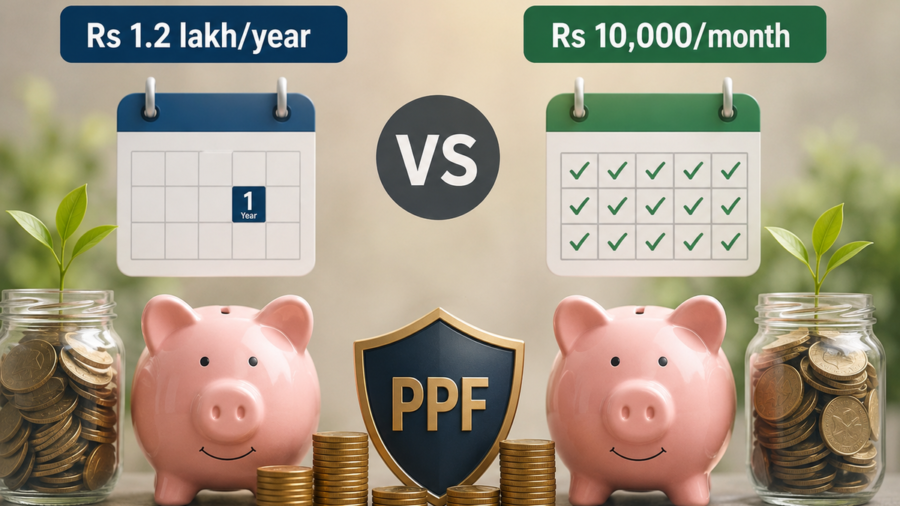
PPF: Rs 1.2 lakh/y vs Rs 10K/m — which builds more?
Synopsis
Investing a lump sum each year in a Public Provident Fund (PPF) results in a significantly higher corpus than making monthly contributions. Over a span of fifteen years, a yearly investment of Rs 1.2 lakh can grow to yield nearly Rs 99,000 more compared to the monthly deposit method. Plus, PPF provides tax advantages at three different stages, with the current interest rate standing at 7.1 percent per annum.

The Public Provident Fund (PPF) is a government-backed small savings scheme, where investors can invest to create a tax-free corpus in the long term. The Finance Ministry reviews the PPF interest rate along with other small savings scheme rates every quarter. For the July-September quarter, the rate of interest in the PPF is 7.1% per annum. The scheme has a maturity period of 15 years. But which investment frequency can help you gather a larger PPF corpus in 15 years- Rs 1.2 lakh lump sum investment every year or Rs 10,000 per month?
PPF interest rate
PPF interest is calculated annually based on the lowest balance between the 5th and the last day of each month and is credited to the account at the end of the financial year. The interest is not paid out periodically; instead, it stays invested in the PPF account and helps earn further interest in the following years.
The maturity period in the PPF is 15 years and partial withdrawals are allowed from the seventh financial year subject to rules. Once the 15-year period is completed, the PPF can be extended for another five years, but not beyond that.
The minimum investment in the PPF in a financial year is Rs 500, while the maximum is Rs 1.5 lakh
If you are wondering whether it is better to invest in the PPF every month or make a lump sum investment once a year, the answer depends largely on when you put the money into the account. To get the full benefit of the PPF’s 7.1% interest rate, one can invest the lump sum amount till April 5 of every financial year. The following calculation shows how the two investment approaches, Rs 1.2 lakh lump sum investment per year or Rs 10,000 per month may perform over 15 years.
Maturity amount on monthly investment of Rs 10,000 in PPF for 15 years
If you invest Rs 10,000 every month in the PPF at an interest rate of 7.10% for 15 years, your total investment will be Rs 18 lakh. Over the 15-year period, you may earn approximately Rs 13,55,680 as interest, taking the total maturity amount to around Rs 31,55,680.
Maturity amount on Rs 1.2 lakh lump sum investment every year for 15 years in PPF
If you invest Rs 1.5 lakh every year in the PPF at an interest rate of 7.10% for 15 years, your total investment will be Rs 18 lakh. Over the 15-year period, you may earn approximately Rs 14,54,568 in interest, taking the total maturity amount to around Rs 32,54,568.
Hence, you can see that on investing Rs 1.2 lakh lump sum every year for 15 years, you may earn nearly Rs 99,000 more compared to Rs 10,000/month investment in the PPF.
However, here we are assuming that the PPF interest rate won’t change in 15 years and the lump sum investment of Rs 1.2 lakh per year will be made till April 5 every year.
Tax benefits of PPF
The PPF account is classified as ‘Exempt, Exempt, Exempt’ or ‘EEE’ investment. This means there are tax benefits at 3 stages- at investment, interest and maturity.
However, investment in the PPF provides tax benefit only under the old tax regime and the maturity amount is tax-free if the account is at least five years old.
Calculator used: Axis Bank
(Join our ETWealth WhatsApp channel for all the latest updates)
Add 

(Catch all the Personal Finance News, Breaking News, Budget 2025 Events and Latest News Updates on The .)
…more


Vishal Nirmiti IPO to open on Sep 30; price band fixed at Rs 208-220
By Sohail Khan · 26 Sep
US immigration crackdown hits Kansas beef industry
By Sohail Khan · 26 Sep