PM Modi visit to Uzbekistan, Kyrgyz Republic: Why Central Asia matters for India
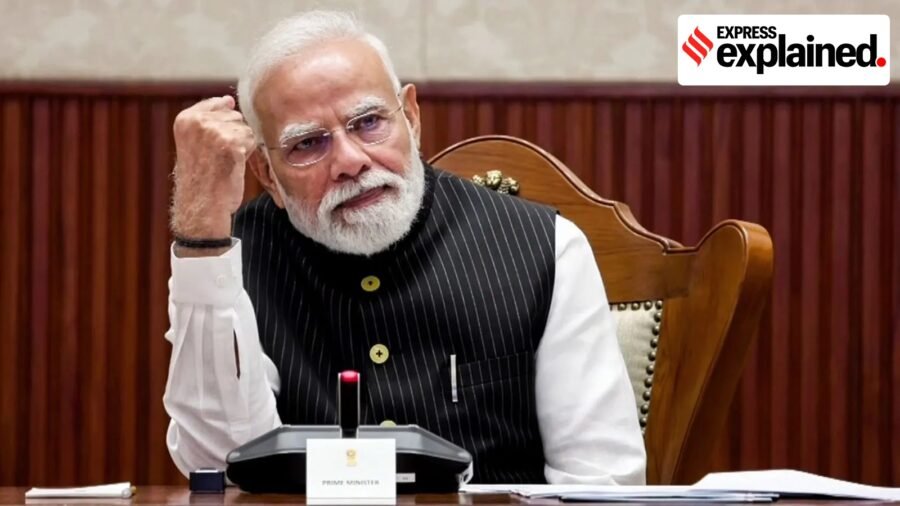
Prime Minister Narendra Modi is headed to Central Asia over the weekend. He will be in Uzbekistan from August 29 to 30 on a bilateral visit and in the Kyrgyz Republic for the 26th Shanghai Cooperation Organisation (SCO) Summit from August 31 to September 1.
While several Indian Prime Ministers, right from Jawaharlal Nehru, have visited Central Asia, India began its focused engagement with these five countries — Kazakhstan, the Kyrgyz Republic, Uzbekistan, Tajikistan and Turkmenistan — only in 2012 when it framed the “Connect Central Asia” policy. The policy got a fillip when Modi became the first Indian Prime Minister to travel to all five Central Asian countries in July 2015. Modi’s visit marks a continuation of this outreach.
What Central Asia offers
Central Asia has always been seen as Russia’s backyard. It has a 20-30% Russian population and the language is also commonly spoken.
Story continues below this ad
The fact that Chinese President Xi Jinping chose to visit Central Asia in September 2022 and visited four of the five Central Asian countries — his first overseas trip after two years of disruption due to the Covid-19 pandemic — speaks volumes about the strategic importance of this region. The region is considered to be extremely rich in mineral and natural resources.
– Kazakhstan has one of the world’s biggest reserves of uranium. It has other minerals too: coal, lead, zinc, gold and iron ore.
– The Kyrgyz Republic has gold and hydro-power.
– Turkmenistan has one of the world’s largest reserves of natural gas.
– Tajikistan also has huge hydro-power potential and Uzbekistan has gold, uranium and natural gas.
Story continues below this ad
Understandably, the world wants to enter this region to tap into the vast potential it offers.
Battle for strategic space
For India, engagement with the Central Asian countries is important for a variety of reasons — security cooperation in the wake of the Taliban takeover of Afghanistan, countering China’s influence, connectivity plans including the International North South Transit Corridor, energy needs (Kazakhstan has uranium reserves and Turkmenistan is part of the proposed Turkmenistan-Afghanistan-Pakistan-Iran gas pipeline), old cultural links and potential for trade.
India considers Central Asia its extended neighbourhood, and its outreach is aimed at security, political and economic benefits. Another sign of its outreach came in January 2022, when New Delhi invited Central Asian leaders for the Republic Day celebration.
China has also made major investments in the region with its Belt and Road initiative. India doesn’t want the post-Soviet space to be captured by the Chinese, and the PM’s engagement is a key mechanism in Delhi’s toolkit.
Story continues below this ad
The challenges
While the economic benefits for India are clear from the vast reserves of mineral resources it can tap, the lack of overland transport access to Central Asia — Pakistan blocks India’s access — remains a major challenge.
This is one of the major reasons for India’s engagement with Central Asia. It wants to integrate the International North-South Corridor with the Chabahar port in Iran to access this resource-rich region.
The Central Asian region is widely seen as the northern boundary of the Islamic world, and with the Taliban’s ascent in the region, the threat of radicalism and possible regrouping of the Islamic State poses a serious security challenge for these countries as well.
But the complication of the Russia-Ukraine conflict may also cause some local churn in these Central Asian countries. Reports suggest that some Russians — who have the money and the skills, but cannot move to the West — are moving to these Central Asian countries for the time being. While the region may benefit from the inflow of talent and funding into their local economies, this may create some tension within the countries.
Story continues below this ad
Civilisational, cultural links
There has been a deep cultural and civilisational connect between India and Uzbekistan for centuries. The only Buddhist monastery known in Central Asia is in Kara Tepa, Termez, Uzbekistan. This was an important centre in the Kushana era, when the Buddhist influence had spread further to Central Asia. There are close to 3,000 shared words in Hindi and Uzbek. There are similarities in cuisine, like ghee-sariyok, samosa-samsa, naan-non and pulao-pilaf.
India is also among the top 10 trading partners of Uzbekistan. The bilateral trade in 2025-26 stood close to $1 billion.
SCO leaders’ summit
PM Modi will visit Bishkek, Kyrgyz Republic, to participate in the 26th meeting of the Shanghai Cooperation Organization Council of Heads of State (SCO CHS), scheduled on August 31 and September 1.
The SCO comprises 10 member states, including India, Belarus, China, Iran, Kazakhstan, Kyrgyzstan, Pakistan, Russia, Tajikistan and Uzbekistan, 15 Dialogue Partners (Azerbaijan, Armenia, Bahrain, Egypt, Cambodia, Qatar, Kuwait, Laos, the Maldives, Myanmar, Nepal, UAE, Saudi Arabia, Türkiye, and Sri Lanka), and two Observers (Mongolia and Afghanistan).
India has been a member of the SCO since 2017.
Story continues below this ad
This year also marks the 3rd edition of the SCO+ format meeting. Apart from SCO Member states, Azerbaijan, Armenia, Vietnam, Laos, Mongolia, Togo, Turkey, Egypt, Turkmenistan, along with multi-nation bodies like the UN and the Collective Security Treaty Organization are expected to attend the SCO+ Meeting.

What an infrastructure of innovation depends on — a responsive legal system
By Sohail Khan · 30 Sep
Trust deficit and caste at India’s premier institutions
By Sohail Khan · 30 Sep
Uttarakhand’s first glacial lake early-warning system: What it will monitor, why it matters
By Sohail Khan · 30 Sep