PM Modi says India can ‘very quickly’ make its place in global space sector: ‘We must create an aura that…’
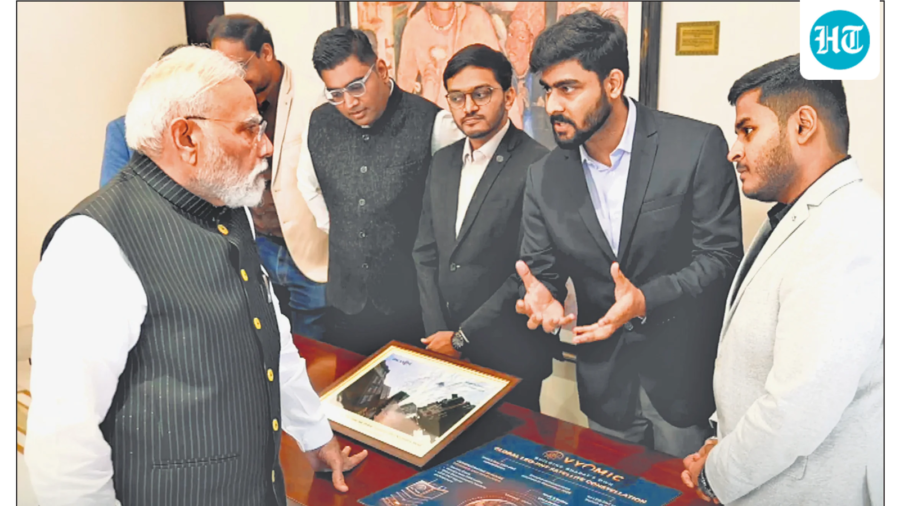
PM Modi urged private space firms to build an ecosystem that attracts global talent and investment, as India targets a larger share in the space economy
Updated on: Aug 24, 2026, 06:13:19 IST
Prefer HTon Google
Share via
Copy link
Prime Minister Narendra Modi has said that India can emerge as a global leader in the space sector, calling on private players to build an ecosystem capable of attracting global talent and investment while reaffirming government’s commitment to innovation.
Modi calls for global talent, investment in India’s space ecosystem
In an interaction with CEOs and founders of 20 private space firms, Modi said India could become a global hub for space start-ups as he highlighted the country’s cost-competitiveness in launching space ventures and its vast domestic talent pool.
“We must create such an aura that people all over the world feel that if they want to build their life, they should come to Hindustan. Join some Indian start-up. Join some Indian space agency,” he said during the interaction that was held on Friday with details released on Sunday. August 23 is marked as National Space Day to commemorate the Chandrayaan-3 mission, which accomplished a safe and soft landing of the Vikram Lander on the lunar surface.
Deep Dive
Powered ByAsk
Private space sector expands as India opens up industry participation
India opened its space sector to private participation in 2020, enabling industry and start-up participation across satellites, launch systems and space applications. This not only marked a major shift towards a broader national space ecosystem but also led to an expansion of the sector, with a government release from August 14 saying that the number of private startups in the country rose from one in 2014 to 440 at present. The Indian Space Policy 2023 further expanded participation across the space value chain.
In his opening remarks, Modi told the entrepreneurs that they trusted the government’s assurance and displayed courage by venturing into a new field. “My view has always been that whatever decisions we take, we must remain consistent in them… so that anyone who wants to take a risk can have confidence… And this was our effort –– to create that trust,” he said.
Private investment in space sector rises nearly six-fold
The global space industry is estimated to be $600 billion and the government, in the release quoted above, said that India currently has a $9 billion share, which is targeted to grow to $40-45 billion over the next decade. According to figures released by the government, private investment in India’s space sector surged nearly six-fold, climbing from $100.5 million in 2021–22 to $618.5 million by March 31, 2026, with $187 million recorded just this year.
“In cost we are very competitive, in talent there is no question at all, and the risk-taking capacity of our people is anyway greater. And because of that we can very quickly make our place,” Modi said.
Start-ups pitch ambitious plans beyond rocket launches
Leading industry players, including Skyroot Aerospace, Agnikul Cosmos, Pixxel, Dhruva Space, and GalaxEye, were part of the interaction with Modi and shared their vision for the sector’s future, which included robotic spacecraft capable of removing dead satellites from orbit, docking and refuelling technologies aimed at establishing a space fuel station, and satellites capable of manufacturing pharmaceuticals in space and bringing them back.
Skyroot Aerospace, which carried out India’s first private rocket launch in July and put the country in a rare club alongside China and the US, described the feat as only the beginning and listed plans to scale up launch frequency.
“Now the world must be searching for India’s start-ups, wondering who is behind this. Because when there is a breakthrough, immediately people’s attention goes there,” Modi also said.
During the interaction, the CEOs also spoke about the wider applications of space technology beyond launches, including global ground-station networks, advanced propulsion systems and space-based innovations in areas such as agriculture. They pointed to a rise in international contracts, growing investor confidence and expanding opportunities in overseas markets, aided by government support for exports and the opening up of the sector.
See Less

Video shows professor grabbing student’s collar during college event; NSUI seeks apology
By Sohail Khan · 25 Sep
What is analogue paneer, and why is FSSAI cracking down on it? | Explained
By Sohail Khan · 25 Sep