On ethanol-blended fuel, sugar and grains, the tail is wagging the dog
India’s ethanol blended petrol (EBP) programme was initiated primarily to benefit the sugar industry. For mills confronting stagnant sugar consumption demand amid rising production, ethanol created an additional revenue stream to enable them to make timely payments to cane farmers.
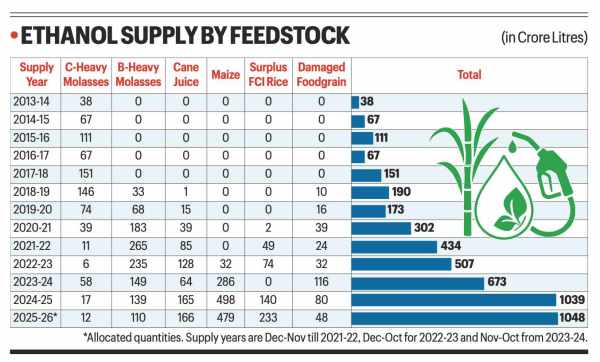
Till 2017-18, all ethanol supplied to oil marketing companies (OMC) came from “C-heavy” molasses — a thick, dark brown final byproduct of cane-juice processing, containing sucrose that mills cannot further economically recover as sugar after three rounds of boiling and crystallisation. From the 2018-19 supply year, mills started producing ethanol from the intermediate-stage “B-heavy” molasses and also directly from whole sugarcane juice syrup. With less sucrose getting crystallised and recovered as sugar, mills could use more of it for fermenting into ethanol. They were incentivised to do so by the Narendra Modi government paying more for ethanol made from B-heavy molasses and direct cane juice/syrup than from the normal C-heavy route. The result: Between 2013-14 and 2018-19, ethanol supplies to OMCs rose from 38 crore to 190 crore litres. So did the all-India average ethanol blending in petrol, from 1.6 per cent to 4.9 per cent.
Advertisement
The real change, however, happened when cereal grains began being used as ethanol feedstock. The process here involved first milling the grains into flour, extracting starch and breaking it down to simple sugars, followed by fermentation, distillation and dehydration to 99.9 per cent pure alcohol or ethanol suitable for blending with petrol.
Initially, the sugar mills themselves installed multi-feedstock distilleries to run on molasses and juice/syrup during the crushing period (November-April) and on grains in the off-season (May-October), when cane wasn’t available. Over time, though, exclusively grain-based ethanol distilleries sprang up across the country. These used either maize or rice, which included surplus and old/ broken/damaged grains sourced from the Food Corporation of India (FCI) as well as the open market.
In 2023-24, the total ethanol supply of 673 crore litres helped achieve an average 14.6 per cent blending level in petrol. Moreover, grain-based feedstock contributed 402 crore litres or 59.7 per cent. From being an alternative, off-season feedstock for distilleries attached to sugar mills, grains thus emerged as the mainstay of the EBP programme — a case of the tail wagging the dog.
Advertisement
For the current supply year ending October 2026, the OMCs have allocated about 1,048.3 crore litres of ethanol among various distilleries. Out of this quantity, just sufficient to meet a 20 per cent national blending target — E20 petrol — as much as 759.8 crore or 72.5 per cent is from grains and only the balance 288.5 crore (27.5 per cent) from sugarcane-based feedstock. Given the high sugar prices today and September-ending stocks projected at a 17-year-low, it is unlikely that the government will allow any ethanol production from direct cane juice or B-heavy molasses in the coming 2026-27 supply year.
Mills would be forced to recover the maximum possible sugar from cane juice, limiting the scope for making ethanol only from the non-crystallisable sucrose in C-heavy molasses. It will ensure no “diversion” of sugar through the B-heavy and cane juice routes. Such diversion amounted to 2.2 million tonnes (mt) in 2020-21 and 3.6 mt, 4.3 mt, 2.4 mt, 3.5 mt and 3 mt in the subsequent five sugar years (October-September). The 3 mt constituted roughly a tenth of India’s estimated gross sugar output of 30.9 mt in 2025-26.
Simply put, we are heading into a scenario where the EBP programme will be almost exclusively fuelled by grains — the opposite of what it was till 2017-18. The accompanying table shows that even in 2021-22, the year when the average blending ratio crossed 10 per cent, sugarcane-based feedstock supplied over 83 per cent of ethanol.
From there, we have now moved to the tail not merely wagging, but taking full control over the dog. While E10 petrol has become E20, the government has already notified standards for E22, E25, E27 and E30 fuel blends. The push for it is basically coming from the distillers, who have set up an aggregate ethanol production capacity of nearly 2,000 crore litres, as against 421 crore in 2014 and the present annual offtake of 1,050 crore litres by OMCs.
It raises the question: Is there enough feedstock to fuel these ambitious targets? In 2026-27, it’s not just sugarcane; even maize availability may present challenges, as El Niño gathers strength and with its effects expected to last through the first half of next year. That leaves only rice — more so, the stocks lying in FCI godowns.
For 2025-26, the Modi government allocated 5.2 mt of surplus FCI rice to ethanol distilleries, which was raised to 7.2 mt in July. At 450-460 litres of ethanol production from every tonne of rice, the 7.2 mt would give 325-330 crore litres. With no sugar diversion and a possible tightening of maize supplies too, the only way to sustain even E20 that requires 1,050 crore litres of ethanol would be to earmark further quantities of FCI rice.
That would be very difficult to justify, not least because rice is a water-guzzling crop. Worse, FCI rice is being sold to ethanol distilleries at Rs 23.2 per kg, with the auction reserve price set even lower at Rs 21/kg for rice with 100 per cent broken grains. For comparison, the all-India modal or most-quoted retail market price for normal rice is Rs 40/kg and Rs 30/kg for broken rice, as per the latest Department of Consumer Affairs data.
Recall the EBP programme’s original purpose: It was intended to help sugarcane growers by improving the liquidity of mills. The programme, likewise, provided an additional demand source for maize farmers whose produce was hitherto going mostly for poultry and livestock feed manufacturing. With ethanol, wholesale market prices of maize in India went up from Rs 13.8-17.8 per kg in 2021 to a Rs 22.1-24.5 range in 2024.
There are two things the government could do.
First, discourage ethanol supplies from standalone grain-based distilleries, especially those significantly reliant on FCI rice. That party must end. Distillers should explore alternative, less water-consuming crops such as bajra and jowar. Their grains contain 58-62 per cent recoverable starch and can give 380-400 litres of ethanol from every tonne, the same as maize. Let millet farmers benefit from higher realisations like maize growers have.
Second, stop setting blending targets and trying to achieve them ahead of time. The EBP programme was successful even with 10-15 per cent blending and there’s no need for posthaste. The government’s chief economic adviser, V Anantha Nageswaran, in an article for this newspaper, has even suggested going back to E10. He’s probably making a virtue out of today’s reality.
The writer is national rural affairs & agriculture editor, . harish.damodaran@expressindia.com

What an infrastructure of innovation depends on — a responsive legal system
By Sohail Khan · 30 Sep
Trust deficit and caste at India’s premier institutions
By Sohail Khan · 30 Sep
Uttarakhand’s first glacial lake early-warning system: What it will monitor, why it matters
By Sohail Khan · 30 Sep