‘Nyaya-Nomics’ Key To Economic Growth: CJI Surya Kant At BRICS+ Legal Forum | VIDEO
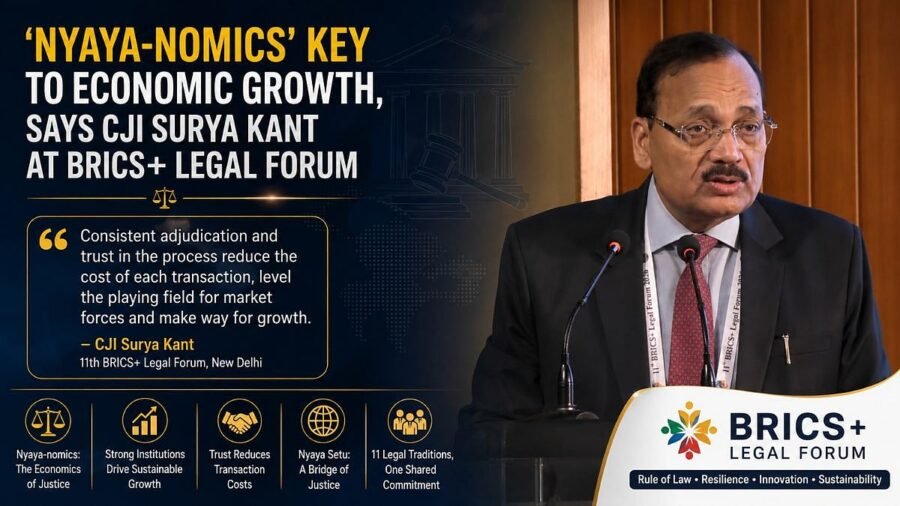
'Nyaya-Nomics' Key To Economic Growth: CJI Surya Kant At BRICS+ Legal Forum
CJI Surya Kant has called “Nyaya-nomics”, or the economics of justice, key to sustained economic growth, stressing that trusted judicial institutions reduce transaction costs and strengthen markets. At the BRICS+ Legal Forum, he also highlighted “Nyaya Setu” as a bridge connecting 11 legal traditions.
<img src="https://media.assettype.com/freepressjournal/2026-08-22/03f0zjhb/Copy-of-Copy-of-Copy-of-Copy-of-Copy-of-Copy-of-Copy-of-Copy-of-Copy-of-Copy-of-Copy-of-Queen-Of-All-Mayhem-2026-08-22T180719.962.jpg?width=1200" alt="'Nyaya-Nomics' Key To Economic Growth: CJI Surya Kant At BRICS+ Legal Forum
CJI Surya Kant stresses the role of trusted judicial institutions in driving sustainable economic growth at the BRICS+ Legal Forum | AI Generated File Image
New Delhi, August 22, 2026: Chief Justice of India Surya Kant on Saturday called for “Nyaya-nomics”, or the economics of justice, arguing that strong and dependable judicial institutions are essential for sustained economic growth.
Addressing the 11th BRICS+ Legal Forum in New Delhi, the Chief Justice of India said the enormous growth that nations are expected to sustain cannot depend solely on geographical advantages or natural resources. Instead, he stressed that trusted institutions, particularly the judiciary, provide the foundation on which lasting economic progress is built.
Delhi: At the 11th BRICS+ Legal Forum, Chief Justice of India, Justice Surya Kant, says, "…Across the years these judgments span, India rose from among the bottom quarter of the World Bank's Ease of Doing Business rankings into the top 100, and enforcing a contract in this… pic.twitter.com/XxweUe8TD5
— IANS (@ians_india) August 22, 2026
Justice Can Drive Growth
The Chief Justice said consistent adjudication and trust in the judicial process can reduce transaction costs, create a level playing field for market forces and, in turn, promote economic growth.
`;
“Nyaya-nomics, or more simply, the economics of justice. It is a fact that consistent adjudication and trust in the process reduce the cost of each transaction built upon it, thereby levelling the playing field for market forces, and in turn, making way for growth,” he said.
His argument puts the justice system at the heart of the economic conversation. Courts are often viewed primarily as institutions for resolving disputes, but the Chief Justice's remarks underline their wider economic role: predictable and enforceable commitments can strengthen the environment in which economic activity takes place, PTI reports.
Institutions, Not Just Resources
The theme of the forum was Rule of Law Frameworks and Institutional Capacity Building for Economic Resilience, Innovation and Sustainability.
Surya Kant said the scale at which India is progressing, a trend he said holds true for each of the BRICS+ nations, owes itself to the nature of its institutions, with the judiciary playing a key role.
“The enormous growth that our nations are expected to sustain cannot solely arrive by the luck of geography or the accident of resources. It is built, deliberately, out of institutions strong enough to be trusted. Perhaps numbers and statistics can make the point better than words alone,” he said.
According to the Chief Justice, no BRICS+ economy, including India, has achieved growth solely through its resources. Development in these countries has been proportional to the enforceability of their commitments.
Building A 'Bridge Of Justice'
The Chief Justice also introduced the idea of “Nyaya Setu”, or a bridge of justice, connecting 11 legal traditions.
“If there is one phrase you absorb into your vocabulary this morning, let it be ‘Nyaya Setu’, a bridge of justice that connects 11 legal traditions which have mutually agreed that trust should be cultivated deliberately rather than awaited passively,” he said.
The idea reinforces his broader message that trust between legal systems cannot simply be assumed. It has to be consciously built, particularly as economies become increasingly dependent on reliable institutions and enforceable commitments.
Strong Institutions Are The Architecture
The Chief Justice said institutions should not be treated as structures created after economic growth has taken off. Rather, they form the architecture that makes such growth possible and sustainable.
“Institutions are not scaffolding we erect around growth once it has already begun, but they are its architecture. Take the architecture away, and in truth, what looks like a rising economy is a stack of good fortune waiting for its first storm,” he said.
Also Watch:
His message at the forum was clear: resources and geography may give economies an advantage, but they cannot guarantee lasting prosperity. For India and other BRICS+ nations, dependable institutions, consistent justice and trust in legal processes will be crucial to ensuring that economic growth remains resilient and sustainable.
To get details on exclusive and budget-friendly property deals in Mumbai & surrounding regions, do visit: https://budgetproperties.in/

Add As a
Trusted Source