New study captures Sun’s early warning signs before solar flares
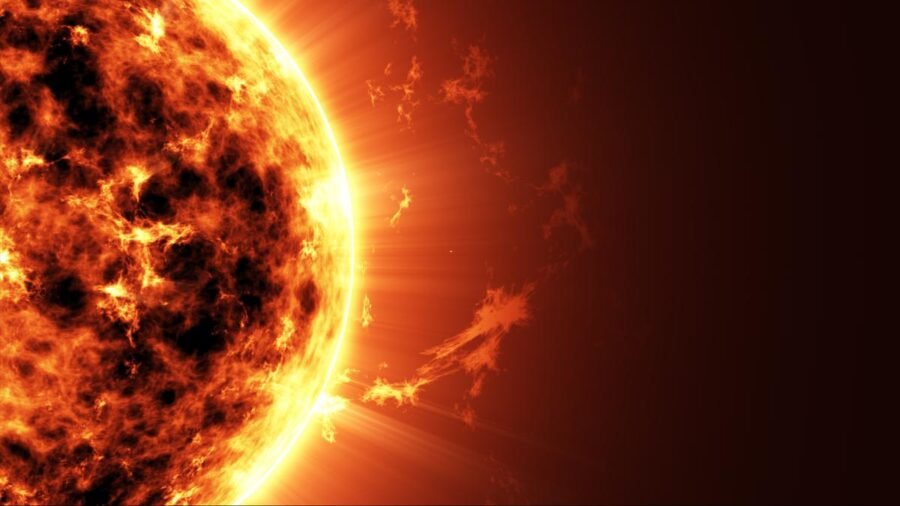
In a new study, scientists have found small, short-lived brightenings in the Sun’s atmosphere that appear in the hours before a major solar flare erupts and cluster around the very spot where the flare later occurs.
The study was carried out by researchers from the Manipal Centre for Natural Sciences and Manipal Academy of Higher Education, along with scientists from the Indian Space Research Organisation (ISRO), the Department of Space, and other academicians.
It used simultaneous ultraviolet (UV) and X-ray observations from three payloads onboard the Aditya-L1 mission.
The Solar Ultraviolet Imaging Telescope (SUIT) payload observed the Sun in 11 near-ultraviolet (NUV) filters, revealing different layers from the upper photosphere to the chromosphere, according to ISRO.
“NUV wavelengths are largely inaccessible from the ground because Earth’s atmosphere absorbs most ultraviolet radiation. Complementing SUIT are two X-ray instruments, the Solar Low Energy X-ray Spectrometer (SoLEXS) and the High Energy L1 Orbiting X-ray Spectrometer (HEL1OS), which measure the X-ray emission produced by energetic processes in the solar corona. Combining these data, scientists study how activity in the lower solar atmosphere is linked to energy release in the corona during the build-up to a flare,” ISRO stated.
Analysing several solar flare events in the Mg II h filter of SUIT, the team found numerous small, short-lived brightening ‘transient events’, occurring in active regions before the onset of major flares.
“Some of these also showed corresponding X-ray signatures, indicating that they involve the release of magnetic energy. These pre-flare transient events clustered around the location where the major flare later occurred. The results suggest that repeated small-scale energy release may progressively destabilise the magnetic field in an active region, eventually leading to a large solar flare,” ISRO said.
The findings provide valuable insights into the physical processes that trigger solar flares and move scientists a step closer towards reliable flare forecasting, which will ultimately contribute to better space weather prediction; help protect satellites, astronauts, and communication systems; and other critical technologies.

Heart attacks in fit women in their 30s and 40s: The hidden risk doctors want you to know
By Sohail Khan · 29 Sep
40 years ago September 29, 1986: Violence and arrests in Punjab
By Sohail Khan · 29 Sep