Nepal’s agony, the Himalayan warning to India
Will India learn now at least?
Will it let Nepal speak to India through its agony what India has refused to hear ?
The Himalaya are not a series of silos — Afghanistan Hindu Kush Himalaya, Pakistan Himalaya, Indian Himalaya, Nepal Himalaya, the Himalaya in Tibet-China, Bhutan. To employ a powerful term I have heard Vadodara-based painter Gulam Mohammed Sheikh use for the Elephanta Caves, the Himalaya are one living rock, silently, broodingly, tense with seismic voltages, glacial stirrings and geological turbulence.
And they spell their uncoded thought in swipes no one can foretell. When, where exactly, with what ferocity, no one knows. And what disasters may radiate from them — through rivers plucked from their courses, rockfalls and landslides depositing mud and silt, turning human habitations into rubble and fertile farms into slime — no one can precisely envision.
Ask those who have heard from their parents and grandparents of the Nepal-Bihar earthquake of 1934 or the Assam temblor of 1950. They will speak of the nightmare.
The question of preparedness
The world has been told — India has specifically been warned — by seismologists of an impending earthquake of humungous scale with the potential of a cataclysm across a great swathe of northern India which lies under the quake-shadow of the Himalaya. It is not as if India’s government has declined to heed the warning. It has done much, as its disaster management agencies will rightly assure us, to be alert to the risk.
But after 26/8 what we need to ask and know is: should what happened in upper Nepal have happened in lower Nepal, and even lower than that, would our ‘preparedness’ have sufficed to save riverside habitations from instant death?
More pertinently, we need to ask and know whether the absolutely fearsome phenomenon of global warming triggered GLOFs (or Glacial Lake Outburst Floods), has led authorities to warn people living in potential GLOF-affected areas in India of the danger they face and advised them on how to face it.
We are, let us face it, in seismic, glacial, climatological and geological innocence.
By ‘we’ I mean we the people of India. Our earth scientists know it all but their jnana is clasped tight in their acharya-mushti-s (’knowledge kept in the teacher’s fist’).
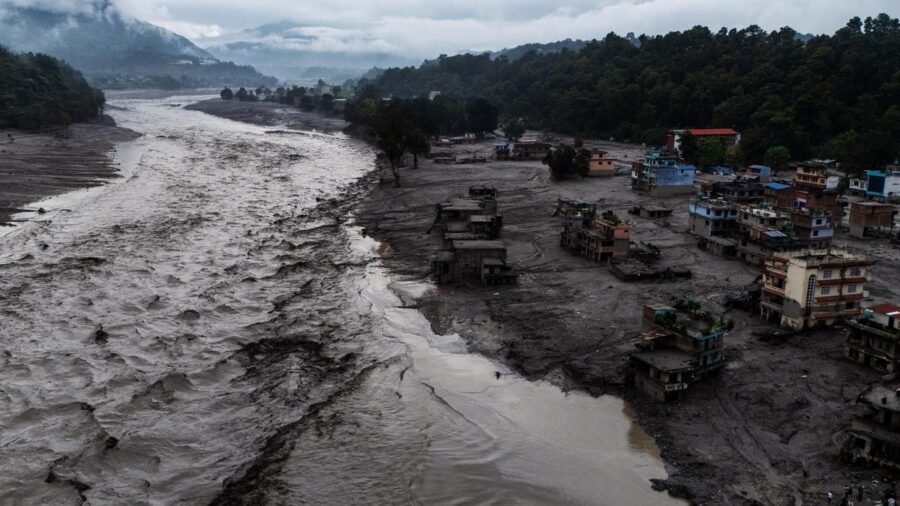
What happened in Nepal on that stricken Wednesday is yet to be fully appraised. We will soon enough know whether it was an earthquake that caused the GLOF, or whether the GLOF resulted in the earth quaking and waterbodies swelling as they never have before.
Whatever happened, India must learn
Be the sequence as it may, the following lessons scream to be learnt by India.
First, the Himalaya, held sacred since memory has served, gestate ‘sure-shot’ danger.
Second, these dangers can now no longer be left to be unravelled in seminars and technical papers.
Third, they have to be made known on a war footing to us, the clear potential victims.
Fourth, and not just made known as in increasing our knowledge but made known as in making us part of a new safeguarding.
Fifth, our scholar-diplomat Shyam Saran has, in two timely and telling articles in The Tribune (“China’s hydel project bodes ill for India”, July 14, 2026) and (“From Nepal to Uttarakhand and China, the mountains are warning us”, August 28, 2026), explained how China’s construction of Medog, the world’s largest hydropower project, at the great bend of the Brahmaputra river just across the border and very close to the Paizhen Fault, could (should there be a major earthquake in the project’s vicinity), cause a massive discharge of floodwaters and debris into India’s northeast. India’s salutary initiatives to bring about a measure of mature civility on the borders with China must now include frankness about the ferocious danger that Medog poses.
Sixth, an urgent review of India’s own built hazards such as dams and reactors in the high risk zones followed by the dismantling of the real ‘baddies’ can no longer be postponed.
Seventh, and no less difficult but no less important, a calibrated but time-bound decongestion of human agglomerations in high-risk zones.
Eighth, if surgical strikes can be used with precision and without excesses against an external enemy to good effect, their civilian equivalent should be deployed to disable that which, though intended for our well-being, has become a danger.
Progress and danger
Marjorie Sykes was a British devotee of India, in the tradition of C.F. Andrews, Verrier Elwin and J.B.S. Haldane. I once heard her say with passion: “Dams are a damnation.” All dams may not be, but some, depending on their location, are. Likewise, some reactors can become rakshasas. And some commercial behemoths, predatory.
A big and great nation can learn from the experience of a small neighbour. Especially when both are perched on the same living rock that threatens to turn into a mass grave.
Gopalkrishna Gandhi is a former administrator who has held diplomatic and constitutional offices

Heart attacks in fit women in their 30s and 40s: The hidden risk doctors want you to know
By Sohail Khan · 29 Sep
40 years ago September 29, 1986: Violence and arrests in Punjab
By Sohail Khan · 29 Sep