Nepal disaster: What is a glacier collapse and how does it happen?
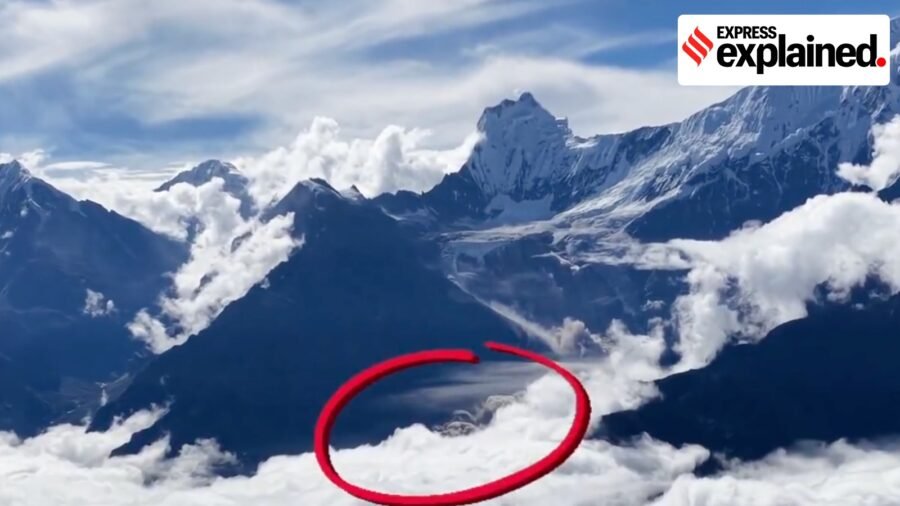
The flash floods that swept through parts of Nepal and Tibet this week have been attributed to a glacial collapse in the Himalayas. It sent ice and rock debris hurtling into the Lhende Khola and Bhote Koshi river system, eventually reaching inhabited valleys.
Generally, a glacial collapse refers to the sudden detachment of a large mass of ice, rock and water from a glacier on a steep mountain slope. Geological factors like earthquakes, temperature changes, or other physical changes unfolding within a glacier can influence such events.
Advertisement
How glaciers collapse
A glacier forms when snow accumulates and survives over several melting seasons. These deposits are compressed into a layer called firn — the midpoint between fresh and glacial snow — before recrystallising into solid ice as part of a glacier.
Once this glacial mass achieves sufficient weight, it can flow outward. “Mountain gradients on which ice moves in a steep flow are the cause of glacial collapse,” glaciologist Iqbal S Hasnain told . “Warming temperatures cause lots of melted water to get collected in subglacial channels. These channels open up after the glacier’s lower portion collapses, leading to water gushing through in large volumes,” he added.
As this mass flows through uneven terrain, the accompanying acceleration creates stress that exceeds the strength of the glacial structure holding the ice together. Sustained movement can ultimately fracture the ice. Structural weakness also comes from surface melting on a glacier. Water can pool inside cracks over cycles of melting and freezing. Eventually, this water pushes hard, splitting the ice all the way through.
Advertisement
Rising frequency
In cases of glacial collapse like the recent one, what sits under the glacier also plays a role. When glaciers rest on soft mud or clay, trapped water moves through the networks of cracks within the glacier to travel downwards. “In these wet base glaciers in the Himalayas, water is collected at the base of the glacier in large quantities and is also occasionally connected by tunnels,” said Hasnain.
When such glaciers collapse, it causes a sudden rush of water that mixes with loose dirt, rocks and riverbed materials. This volatile mixture can race down narrow mountain valleys at great speeds. Another complication is posed by the piles of rock and ice that get left behind, which can block narrow river channels and form temporary natural dams. When such a temporary dam breaks under continuous pressure, a second round of flooding can be unleashed — something also witnessed in Nepal this week.
In recent years, the incidence of glacier breakages has increased, owing to the faster warming of the Himalayas due to climate change. As physical conditions become more challenging, this can affect how future search-and-rescue missions are conducted. Advanced preparation via remote seismic monitoring and high-altitude early warning systems then takes on greater importance.
Experts also note the need for correctly zoning critical infrastructure like hydropower plants so they are not erected in high-risk areas. Events like the Nepal floods also point to the need for international cooperation so that upstream glacial instability is communicated downstream before disaster strikes.

What an infrastructure of innovation depends on — a responsive legal system
By Sohail Khan · 30 Sep
Trust deficit and caste at India’s premier institutions
By Sohail Khan · 30 Sep
Uttarakhand’s first glacial lake early-warning system: What it will monitor, why it matters
By Sohail Khan · 30 Sep