Mumbai’s endless road-digging may finally stop as BMC plans policy to fix utility lines
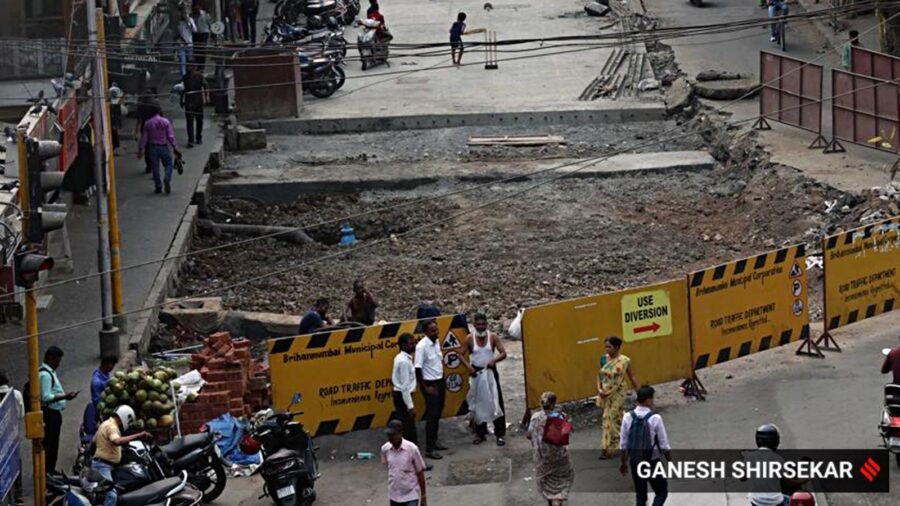
Frequent road digging for laying and fixing utility lines — which has emerged as a menace in Mumbai — may finally stop as the Brihanmumbai Municipal Corporation (BMC) plans to introduce a new trenching policy for the city. According to Mumbai municipal commissioner Ashwini Bhide, BMC’s new trenching policy is likely to be prepared by September 1 and will be implemented for utility agencies, following the standing committee’s approval.
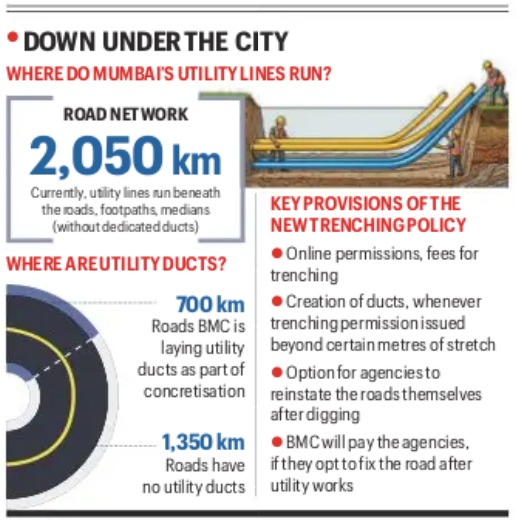
The new policy seeks to launch an online portal for issuing permissions, mandate the creation of utility ducts along roads when issuing trenching permissions, and incentivise the reinstatement of trenched roads for the agencies and utility owners, has learnt.
In what Bhide deemed an attempt at “bringing method to the madness”, she said that the new trenching policy seeks to eliminate human interventions and incentivise the use of dedicated utility ducts to improve the quality of roads.
“The trenching policy will be designed in such a way that the utilities will have an incentive to use dedicated ducts. Under the new policy, everything will be streamlined online. Under the existing policy, the utility owners end up leaving the roads shabby as there were too many players. We are trying to remove all the bottlenecks and systematise the entire process of trenching to improve the quality of roads,” Bhide told .
Mumbai has a road network of 2,050 kilometres. Owing to the lack of space, it is beneath the surface of roads, footpaths and medians that a vast network of utility cables, including electricity lines, telecommunication cables, gas lines, old BEST cables among other channels, are laid. To install new lines or fix the existing utilities, agencies are compelled to dig up the road surface beneath which the utilities lie.
Such regular trenching poses hurdles for motorists and pedestrians while also taking a toll on the quality of roads.
“We have roughly 27 to 30 utilities, and they need to be constantly repaired or augmented, for which trenching is critical. However, trenching can damage bituminous roads as water gets in. While the concretisation drive has been able to fix this, we have to cut the road for fixing utilities,” Bhide told .
Story continues below this ad
The new policy
In a bid to eliminate frequent digging of roads, the new trenching policy seeks to mandate creation of new utility ducts while issuing trenching permissions to utility operators and agents.
A utility duct will entail a dedicated corridor of pipelines up to 300-350 mm in surface area, under the ground, which will be reserved strictly for utility lines. These ducts will be lined with chambers which can be opened to access the lines, thereby eliminating the need to dig up the roads.
At present, the BMC is laying utility ducts across 700 km of roads as a part of its mega-concretisation drive. However, 1,350 km of Mumbai’s roads remain without dedicated utility corridors — a gap which the authorities seek to bridge with the new policy.
 A utility duct will entail a dedicated corridor of pipelines up to 300-350 mm in surface area, under the ground, which will be reserved strictly for utility lines.
“Under the new trenching policy, whenever we issue permissions for a certain metre of stretch and the roads will have to be excavated, we will ask the agency to install a duct corridor. The agencies will be given the option to either create the duct themselves, or we will create the duct for them. As more of such dedicated utility ducts come up, the agencies can simply open the chambers going forward to fix the problem,” said a civic source.
Story continues below this ad
In pockets where the utility lines cannot be accessed through the duct chamber, the BMC’s policy is eyeing to incentivise the process of road repairs by giving agencies an option to fix the dug up roads by themselves.
“Every time a road is dug by agencies for utility repairs, the BMC fixes the road and levies a huge sum on the agency. With the new policy, we are working to give the agencies an option to repair the dug up roads. The BMC will also pay them for reinstating the road after utility repairs are complete,” a source in the BMC, privy to the developments, said.
The new policy also seeks to make the entire process of issuing trenching permissions and charging fees “faceless”, by launching a new online portal.
Taking shape
At present, the policy is in the development stage with municipal commissioner Bhide stating that the BMC is targeting to finalise the new trenching policy by September 1. The proposal of the draft will be implemented for agencies to adhere to if it gets the nod of the civic standing committee.
Story continues below this ad
According to senior civic officials, the new policy has been drafted in consultation with multiple stakeholders, including agencies and aggregators handling utility provisions. In Mumbai, over 90 per cent of the existing utility corridor consists of electricity and telecommunication lines. “Ultimately, we want to reduce frequent trenching by progressively creating new utility ducts in the city,” an official said.
The new framework marks a revision of the existing trenching policy, which was issued in 2015.