Meet man who strung racquets for Lin, Lakshya & 3 decades of badminton’s best
“When Lakshya Sen is on a winning run, his racquets need more stringing than anyone. His coach would bring five or six racquets after the game and he is probably our biggest customer when he is winning.”
“Lin Dan had a very unique grip. Half of his handle was strapped while the other half, the tail, used to be wooden.”
“The Chinese team carries their own stringers, given the large size of their squad. However, despite that, some of their players prefer to come to our stringing station during majors.”
Story continues below this ad
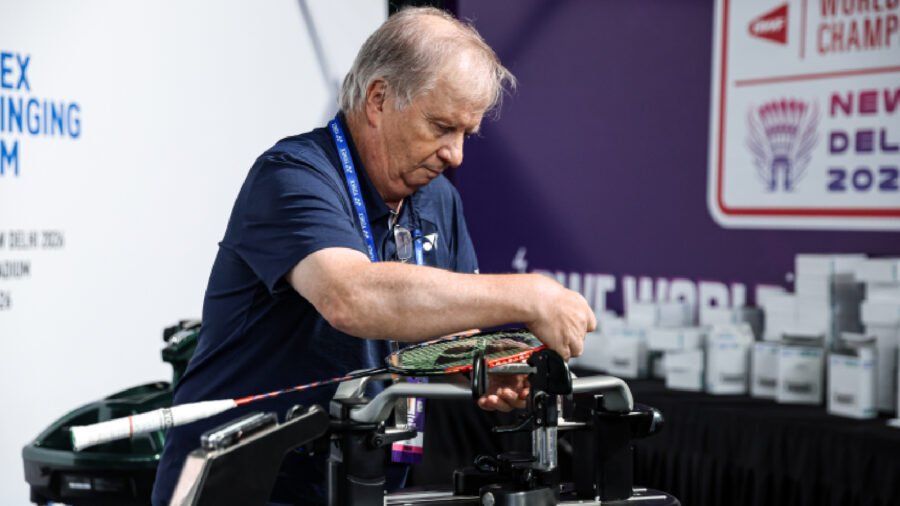
These are some of the anecdotes Yonex’s head of stringing, Mark Lawrence, has to tell.
In a career spanning over three decades, Mark has strung thousands of racquets for top shuttlers across the world, and has watched stringing evolve from a sidelined activity into an absolute necessity at badminton’s majors.
“I started back in 1994 when Yonex wanted to show people what stringing is. I had a shop and used to string racquets for then world No. 1 Morten Frost. Yonex asked me to be part of the stringing team at the 1994 edition of All England, and well, I haven’t stopped since then,” Mark told .
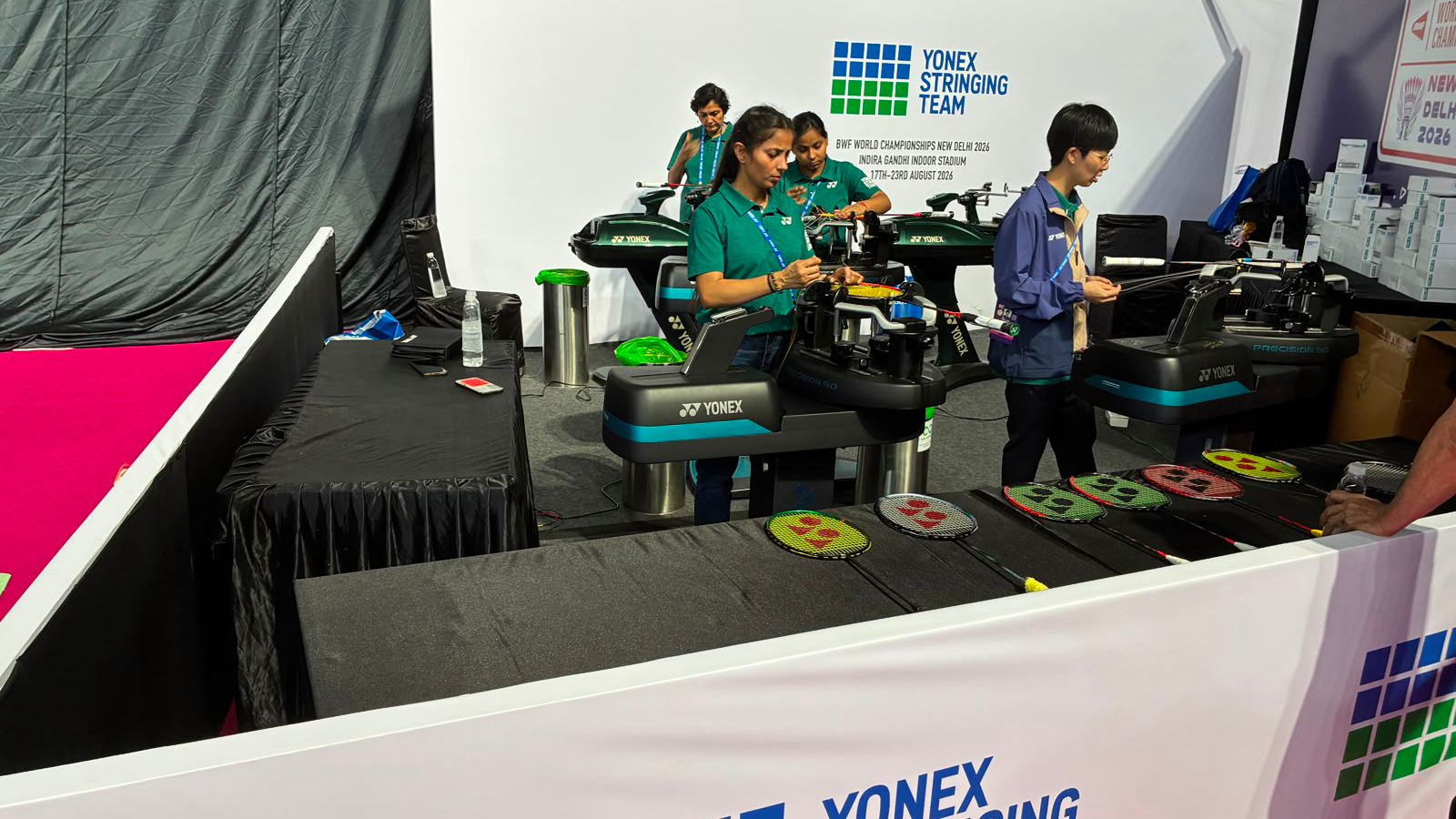 Every major badminton event, the World Championships, Thomas and Uber Cup, Sudirman Cup, Junior Worlds, now has a dedicated stringing station, usually belonging to brands like Yonex, Victor or Li-Ning, where shuttlers get their racquets fixed before and after matches.. (Credit: Yonext)
Stringing station
Every major badminton event, the World Championships, Thomas and Uber Cup, Sudirman Cup, Junior Worlds, now has a dedicated stringing station, usually belonging to brands like Yonex, Victor or Li-Ning, where shuttlers get their racquets fixed before and after matches.
Story continues below this ad
There was a time, though, when stringing was an afterthought at these events.
“When the All England moved from Wembley to Birmingham, that is when this concept of stringing the racquets during a tournament started,” Mark recalled.
Now, stringers get a full team and a dedicated space to cater to players’ needs. “Now, you see all this area which is well lit and we have multiple staff. Earlier we used to do the stringing on the side of the courts while matches were going on. Ten years into my career, I have done stringing on the arena floor.
Somewhere around 2005 or 2006, a dedicated space for stringers started taking shape,” Mark said.
Story continues below this ad
Asked about the busiest tournament he’s been part of, Mark said, “When World Championships and Sudirman Cup were held together, that used to be the busiest time for us.”
At the Delhi World Championships, the first two days were the busiest for Mark and his team. “We had close to 500 stringings. The early days are busy, as there are so many players playing in a day. Once the tournament settles down, our work also gets a little easier, with fewer requests coming in,” he said.
Stringing stations at major championships also give players from countries outside badminton’s traditional powerhouses, Brazil, the UAE, Myanmar, a chance to access the best strings. “Of course they have local stringers in their countries, but players from developing countries do come and take advantage of the fact that they are getting free stringing and good-quality strings,” Mark said.
Stringing tension has gone up
Beyond stringing as a service, string tensions in racquets have risen over the years. Tension is essentially the tightness of the string on the racquet: higher tension makes the string bed firmer and offers more control, while lower tension makes it softer and gives it more power.
Story continues below this ad
“When I started, the average tension for a racquet used to be 28 or 29, but now anything above 30 is the standard. The Danish players used to have higher tensions back in the day,” Mark said.
Interestingly, the highest and the lowest tension Mark has ever strung both belong to Japanese players. “Kenichi Tago, one of the All England runners-up, had the highest tension I have ever done. He had string tension over 34 lbs. The lowest I have done is Akane Yamaguchi, who uses a tension of 25 lbs, while the average tension in women’s singles hovers around 30,” he said.
“Lower tension complements Yamaguchi’s game. She is not the most powerful player, so with the lower tension, she gets a slightly bigger sweet spot in the middle of the racquet, which gives her good control. When the tension is lower, the shuttle stays for a fraction longer,” Mark explained.
As he headed back to the stringing area, Mark quipped, “Finally, I can watch the matches in peace, as there are no stringing requests. I missed watching PV Sindhu and Ayush Shetty in action.”

Soccer-Kane considers NFL kicking career after soccer
By Sohail Khan · 24 Sep