Kerala is having fewer children. This is bad news for teachers
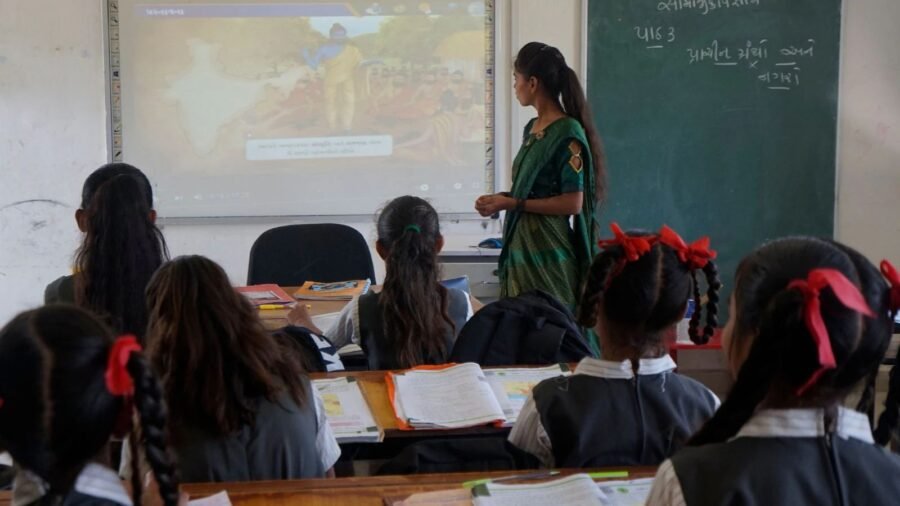
For 40-year-old S Valarmathi, making the rank list for lower primary teachers in government schools in Kerala was supposed to be a step towards a job she had long dreamed of.
Instead, with only a fraction of those on the 2025 rank list getting jobs, that dream has turned into a 41-day indefinite agitation in front of the state secretariat, where she has joined fellow rank holders demanding that the government give them their due.
The state government’s Public Service Commission (PSC) recruited as many as 6,114 people as teachers in government lower primary schools for a period of three years starting June 2025. However, only 239 candidates have been appointed so far.
And since each such ranklist is for a maximum period of three years, and the existing one expires in May 2028, aspirants say time is ticking.
Stakeholders cite one key reason teachers are not being placed despite making the rank list: the fall in student enrolment, particularly at the lower-primary level, linked to the state’s declining birth rates.
“I passed the teachers’ training course (TTC) 16 years ago, in 2010. In between, I worked in government schools for a few years on daily wages. This job has been my dream. I am a single parent of two children, who are with my mother in Palakkad as I sit on protest here. As 40 years is the upper limit to apply for a government job in Kerala, age is not on my side,” said Valarmathi.
Balkis K F, 27, completed the TTC in 2017 and has worked in various schools on a daily-wage basis. She figured in the 2019 supplementary rank list but did not secure a job as no appointments were made at the time.
Story continues below this ad
“I completed my TTC when I was 18. My husband is a farm worker. Aided school managements are demanding huge sums, ranging from Rs 30 lakh to Rs 40 lakh, and candidates like me cannot afford to pay that much to get a job in the sector,” she said.
Similarly, hope is slowly giving way to frustration for 36-year-old Manzoor, who worked as a salesman in the UAE for 14 years before returning to Kerala and clearing the recruitment process — only for the job to remain elusive.
Dwindling enrolment
At the start of each academic year in June, the Education Department conducts a process called staff fixation in all government and aided schools based on the number of students enrolled. In the lower primary segment, the teacher-student ratio is 1:30.
When a teacher retires, that vacancy can be filled only if that particular school continues to have the required number of students. If it does not, the junior-most teacher can be shown the door.
Story continues below this ad
According to Kerala School Teachers’ Association general secretary T K A Shafi, scores of teaching jobs in the government sector have disappeared over the years for want of students. “As per the government decision, teachers who joined schools until 2022 are protected, meaning they can be redeployed if needed. But those appointed after 2022 are at risk of job loss, and have to wait until a new vacancy emerges. Unfortunately, such vacancies are also rare,” he said.
An analysis of student strength in Kerala’s government and aided schools between 2021-22 and 2025-26 shows that the system lost 3.33 lakh students in four years – with the figure dipping from 38.68 lakh to 35.35 lakh.
And, as per data presented in the Assembly, 2,06,706 students enrolled in the first standard in government and aided schools that follow the state board syllabus this year. In the last academic year, this figure was 2,34,476.
Kerala’s crude birth rate was 17.67 in 1992 and stayed around that level for several years. It slipped to 16.63 by 2006 and 15.75 by 2010. The rate fell below 15 for the first time in 2016, at 14.48, before dropping again to 13.79 in 2019. It then declined by 1.02 between 2019 and 2020, and by 0.83 between 2020 and 2021.
Story continues below this ad
Apart from the declining birth rate, another factor is that many parents are opting to send their children to private CBSE schools.
The demands and response
Early this week, the Kerala Lower Primary School Teachers Rankholders Association submitted a charter of demands to the state government, including changing the teacher-student ratio in lower primary schools from 1:30 to 1:25. They also sought the introduction of a head teacher post without teaching duty for primary schools with a student strength above 150. Another suggestion was to ensure that for every two vacancies that arise in aided schools, one is filled from the PSC list.
Education Minister N Samsudheen, who held discussions with protesting rank holders to end their indefinite hunger strike, said the government has sought 45 days to study their demands, primarily the change in the teacher-student ratio, since it will impact the entire education department.
“We have assured job security for teachers who are appointed in schools. If existing norms do not give that security, the government has promised to bring in new regulations,” he said.
Story continues below this ad
But experts point out that changing the teacher-student ratio could lead to a huge financial liability for the government and prompt similar demands in the upper primary and high school segments.
As per the budget estimate for 2025-26, a break up of the state’s expenditure on education showed that out of Rs 29,164.72 crore, the share for elementary and secondary school sectors together was Rs 20,168.15 crore (around 69 per cent). Of this elementary segment’s share was 9,803.54 crore. As per the CAG report on the state finances 2024-25, the committed expenditure, which includes salaries, wages and pension bills, form 63.23 per cent of the revenue expenditure of the state. Hence, any change in teacher student ratio in Kerala will have a major impact on the state’s finances.

Family gets court relief, but how to find 43-year-old pushed into Bangladesh?
By Sohail Khan · 9 Sep
‘How much depth do they have?’: BJP President questions Rahul Gandhi’s youth events
By Sohail Khan · 9 Sep
Congress has history of insulting Dalits, says Nitin Nabin on ‘purification’ issue
By Sohail Khan · 9 Sep