Israel’s West Bank push imperils long-term peace

While global attention has been fixed on Gaza, Israeli settlers have been intensifying violence against Palestinians in West Bank — under Israeli occupation since 1967 — the larger of the two territories that constitute Palestine. A UN briefing to the Security Council on August 11 said that “the West Bank is at the breaking point”, with 76 Palestinians killed in 2026 by Israeli forces or settlers. In the same period, UN data reveal that about 3,800 Palestinians, nearly half of them children, have been displaced by settler violence, demolitions and evictions. Settlement expansion is widely seen as a state project, as underlined by the Benjamin Netanyahu government’s plans to open tenders for the construction of 1,200 settlement homes. Against this backdrop, the joint statement by the UK, France, Germany, Italy and Canada calling the tenders “unacceptable” and urging Israel to “retract the plans immediately” is welcome. Eight Muslim-majority nations, too, have criticised the plans; the US has expressed opposition but stopped short of condemnation.
Successive Israeli governments have facilitated the growth of settlements in West Bank, but this has accelerated since Netanyahu returned to power in 2022, backed by far-right parties championing the settler cause. Of course, Israel’s security concerns are not to be dismissed, particularly after the October 7 terror attack by Hamas. But the E1 project would not only exacerbate the displacement of Palestinians, it would also defeat the prospects of a contiguous and viable Palestinian state. All this is consistent, however, with the public posturing by Netanyahu and his allies. Less than a year ago, during a visit to a West Bank settlement, the Israeli PM said: “There will never be a Palestinian state. This place is ours.” With elections looming and the tender deadline falling just a week before polling day in late October, the timing of E1 may not be incidental.
Advertisement
The events in West Bank are part of a systematic effort to alter its demography and geography. Announcements such as last year’s recognition of the State of Palestine by multiple Western countries look ineffectual unless backed by pressure on Israel. That the US, which has the greatest leverage, continues to grant Israel cover points to the difficulty of course correction or change.

Japanese fighter aircraft took off from Indian soil this week. Here’s why it matters
By Sohail Khan · 25 Sep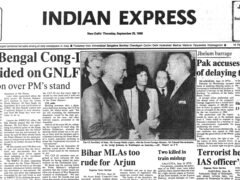
40 years ago September 25, 1986: Congress undecided on GNLF
By Sohail Khan · 25 Sep
‘Public order’ vs ‘law and order’: What Jammu & Kashmir HC ruled on PSA
By Sohail Khan · 25 Sep