India’s growth to stay at 7% despite global uncertainties: Nirmala Sitharaman
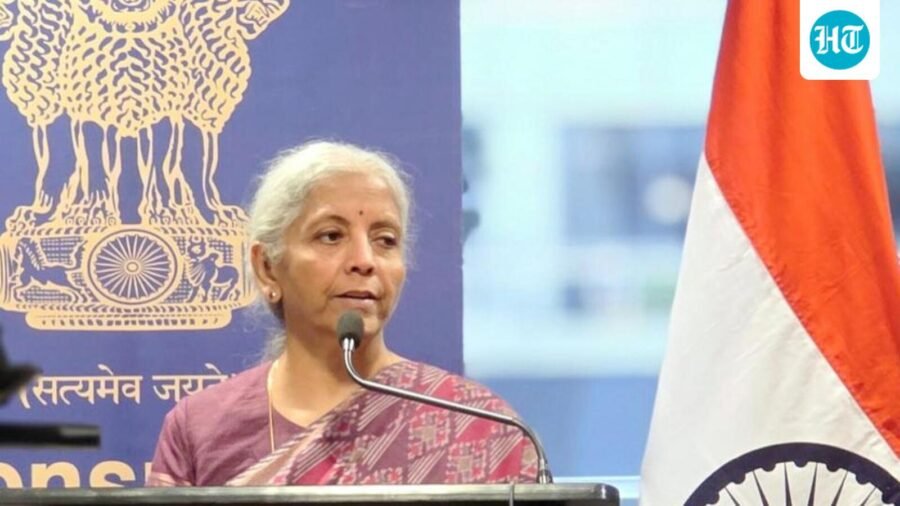
Finance minister Nirmala Sitharaman said India’s economy will sustain 7% growth despite wars, tariff uncertainty and disruptions to global energy and fertiliser supplies.
Updated on: Aug 30, 2026, 16:12:13 IST
Prefer HTon Google
Share via
Copy link
India’s economy has been growing at 7% or more since the Covid-19 pandemic and is expected to maintain the momentum despite global uncertainties, Union finance minister Nirmala Sitharaman said while addressing the Indian diaspora in Chicago.
Sitharaman said India had “recovered well” from the pandemic and continued to sustain growth at 7% or more, even as global uncertainties have multiplied due to wars, tariff issues and disruptions to energy and fertiliser supplies through the Strait of Hormuz. “We thought, we saw the worst when we went through Covid,” she said.
“This year too, our growth will be at that range,” she said, pointing to global uncertainties caused by two wars, tariff issues and the situation at the Strait of Hormuz, which is disrupting global supplies of energy, fertilisers and other essential commodities.
The finance minister’s statement came close on the heels of the Reserve Bank of India’s latest growth projection on August 5. According to the RBI, India’s real gross domestic product (GDP) growth for 2026-27 is projected at 6.7%.
The RBI increased its latest GDP growth rate projection by 10 basis points from its June estimate as the economy weathered the storm generated by a turbulent global geopolitical environment, trade-related uncertainties and an unpredictable monsoon in the first quarter of 2026-27.
Sitharaman said notwithstanding the breakdown of global energy and fertiliser supply chains, the government shielded its citizens. Despite the Hormuz crisis—which the finance minister termed a “big challenge”—India kept itself “well provisioned” to meet the fertiliser requirements of farmers without any additional cost, and energy was made available to every household.
India imported nearly 80% of the fertilisers it consumed through Hormuz, including urea, diammonium phosphate (DAP) and potash, she said. As a result, Indian farmers were left without fertilisers, which she recalled as an “unthinkable” situation. But the government arranged fertilisers through various routes and the country is “adequately” stocked.
While the crisis has been managed, the government paid a huge price to procure fertilisers for farmers from global suppliers, she said. The government continues to give urea at ₹300 per bag to Indian farmers, while its procurement cost is ₹3,000 per bag, she said. “So, ₹2,700 is the subsidy we give per bag of fertilizer,” she said, adding that “there is no shortage” of fertilizer for farmers and no burden of the cost is shifted to them.
The finance minister said irrespective of global uncertainties, India is marching on the reform path with its focus on bilateral trade and investment cooperation with several economies and accelerating the domestic engine of growth through capital investments for their multiplier effects. “So, reforms continue. We are also talking with several countries for bilateral investment treaty and also bilateral trade agreements because multilateral institutions are very slow…, she said.
Talking about fiscal management, she said, “We have set ourselves a certain target, which is to bring the borrowing down to the 50% level of GDP by 2030. Therefore, I will be working on that path. There are advanced economies whose debt is well over 200% of their GDP even now. We have given ourselves a fiscal discipline path on the fiscal deficit as well. We have fulfilled the trajectory. The last mile that had to be reached by 2025-26, we have reached,” she added.
“The world has witnessed the fiscal prudence of Hon’ble Prime Minister Shri Narendra Modi when he was Chief Minister of Gujarat and when he is the Prime Minister of the country. Our credit ratings are improving. But that’s not by cutting corners. That’s not by stopping the resources which have to go for social welfare. It is through proper management of the economy,” she said.
She said 2047 is the target year set for achieving Viksit Bharat. “It’s hardly 20 years from now. So, the speed and scale with which the reforms are happening require a lot more support. Lots more support from people who are talented and have exposure. Lots more support from people who can give ideas for us to carry it forward. And, above all, support in terms of capital, which is so required for a country to meet all its aspirations,” she added.
See Less
Indirectly mining affected people in Odisha get substantial DMF fund, CAG unearths
By Sohail Khan · 29 Sep