India strike late to leave Sri Lanka 229/6 after a sluggish day of bowling
With 213 runs in the bank, most teams would be tempted to enforce the follow-on. Yet, as India wrapped up Sri Lanka’s first innings early on Day 4 in Colombo, Shubman Gill may have had second thoughts, bowling the hosts out for 290 with the pitch still looking good to bat on.
He opted to send them back in, perhaps mindful of the weather. But at 178 for 2, with Pasindu Sooriyabandara and Kamindu Mendis in the middle, the decision looked to have backfired.
The bowlers found a way back into the match in the third session, though, to leave Sri Lanka precariously placed at 229 for 6, with a lead of just 16.
Story continues below this ad
For much of the day, India’s attack struggled to sustain any real pressure on a surface offering little assistance.
It began promisingly. Mohammed Siraj removed Lahiru Udara for 3 and bowled a disciplined opening spell, hitting good areas and giving Sri Lanka little room. Prasidh Krishna supported him with tight lines, though without the same threat.
Siraj’s injury changed the equation. Attempting a catch in the deep to dismiss Sooriyabandara, he landed awkwardly and hurt his rib, forcing him off the field. India were without their most experienced fast bowler, while the spinners were finding little consistent turn or bounce.
Sri Lanka showed why the surface called for patience over attacking fields. Kamil Mishara and Sooriyabandara put together 58 for the second wicket, using sweeps and calculated footwork to disrupt the spinners. Jadeja eventually had Mishara lbw for 32, but India couldn’t build on the breakthrough.
Story continues below this ad
Manav Suthar and Saransh Jain were accurate, but accuracy alone wasn’t enough. Sri Lanka rotated the strike whenever the bowlers missed their lengths, taking on Suthar in particular and forcing him into containment, bowling defensive lines without close-in fielders.
Jadeja remained India’s most threatening spinner, varying his pace and attacking the stumps, but the batsmen used sweeps, slog-sweeps and the odd charge down the pitch to disturb his rhythm.
The problem wasn’t that India bowled badly throughout. It was that they couldn’t sustain pressure for long enough. Each time the bowlers strung together quiet overs, Sri Lanka would rotate the strike or release the pressure with a boundary.
Jain had a similar problem. He was accurate, and occasionally found turn, but lacked the penetration to consistently trouble the set batsmen. No-balls disrupted his rhythm too, two in the middle session, another later.
Story continues below this ad
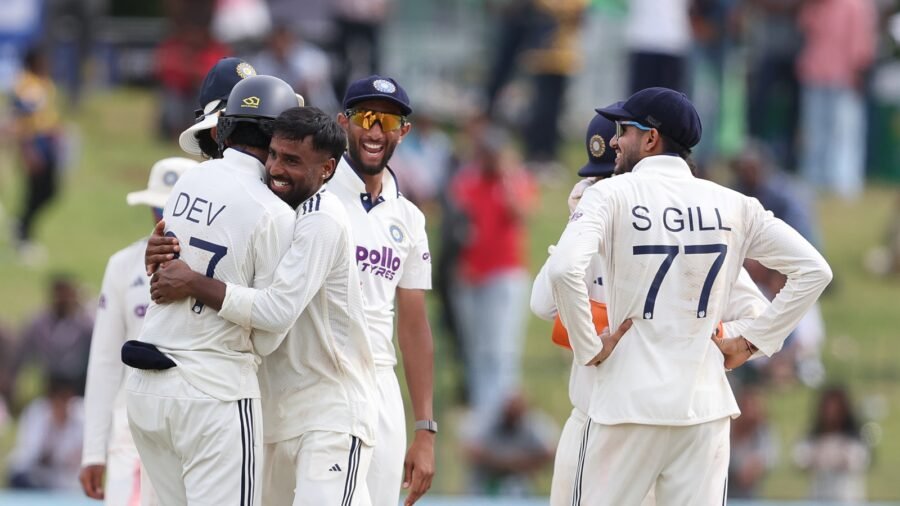
India’s breakthrough came through Prasidh. Kamindu Mendis had grown increasingly comfortable against both pace and spin, but in the 44th over, a rising delivery struck him high on the bat as he pulled. Gill ran back and completed an excellent diving catch.
The third session showed what India could have produced earlier. The attack became more disciplined and aggressive, particularly against the lower order. India used close catchers; Prasidh bowled short, while the spinners attacked the stumps.
The pressure finally produced a cluster of wickets. Suthar removed Dhananjaya de Silva for 23, not through a brilliant delivery so much as sustained pressure forcing a mistake. Dhananjaya tried to clip a flatter ball into the leg side, but the inside edge popped up off the thigh pad, and Devdutt Padikkal took the catch.
Then came the biggest wicket of the innings. Sooriyabandara, who had scored 80 in the first innings, was within sight of a hundred on 92. Suthar anticipated his charge, slowed the delivery down and pushed it wider outside off. Sooriyabandara couldn’t reach it, and Rishabh Pant completed a straightforward stumping. It was sharp bowling awareness from Suthar, and sharper glovework from Pant.
Story continues below this ad
That dismissal opened the door, and India went after the next batsman. Niroshan Dickwella edged Suthar for four and swept him for a single before Jain trapped him lbw for 6.
From there, India’s bowling tightened further. Prasidh used the short ball against Sonal Dinusha, with leg slip and leg gully in place. The left-hander was forced to duck, sway and defend. At one stage, Sri Lanka went 36 balls without scoring.
The passage showed India had finally found the right method: making the lower order defend for long periods, and building pressure through dot balls.
At 229 for 6, India had reduced the scoring and begun to threaten a real collapse. That was when the weather intervened.

Giants QB Dart to have season-ending surgery
By Sohail Khan · 24 Sep