India, Japan roar back at ‘unilateral’ Dragon
Benchmarks
Nifty24,231.85153.55
FEATURED FUNDS★★★★★
Motilal Oswal Midcap Fund Direct-Growth
5Y Return
23.26 %
Invest Now
Enter search text:
Business News›News›Defence›In implicit message to Beijing, India and Japan oppose unilateral actions impeding freedom of navigation
Read Today's Paper
In implicit message to Beijing, India and Japan oppose unilateral actions impeding freedom of navigation
Synopsis
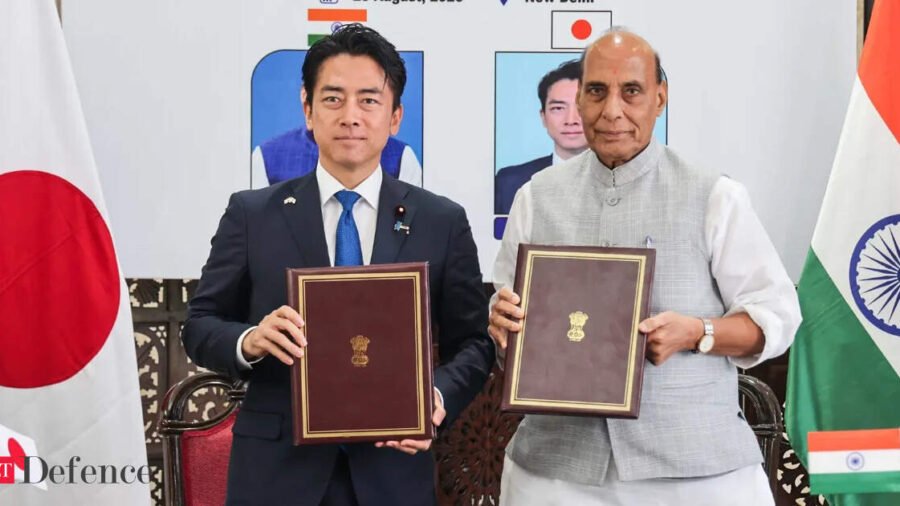
India and Japan on Thursday signed a maritime security pact and agreed to deepen defence cooperation to support a free and open Indo-Pacific. Defence ministers Rajnath Singh and Shinjiro Koizumi opposed unilateral attempts to alter the status quo by force or coercion, while backing joint naval shipbuilding, intelligence-sharing and technology cooperation.
 ANI
ANINew Delhi: India and Japan on Thursday sealed a pact to bolster their maritime security ties and vowed to synergise bilateral military cooperation to work towards a free and open Indo-Pacific, an assertion that came amid China's increasing military muscle-flexing in the region.
In their talks, Defence Minister Rajnath Singh and his Japanese counterpart Shinjiro Koizumi expressed their strong opposition to any unilateral actions that impede freedom and safety of navigation and overflight, as well as attempts to change the status-quo by force or coercion.
Also read: India, Japan deepen maritime security ties, agree to explore joint naval shipbuilding
The remarks are seen as directed against China as both India and Japan are concerned over Beijing's offensive military posturing in South and East China seas.
In taking forward their robust defence ties, India and Japan agreed to explore the possibility of joint naval shipbuilding and design by leveraging Japan's technological expertise and India's production capabilities besides agreeing to establish a working group to advance cooperation in intelligence, equipment, technology and industrial domains.
The two sides also agreed to promote cooperation through the Indo-Pacific Logistics Network (IPLN) to support partner countries in the event of natural disasters.
With a view to taking a comprehensive perspective of the Indo-Pacific and contributing jointly to peace and stability in the region and the world, Singh and Koizumi concurred on deepening cooperation with third countries, through high level exchanges, exercises and other relevant initiatives, a joint statement said.
It said the two ministers affirmed their commitment, to further deepen defence cooperation to realise a free and open Indo-Pacific.
"The two ministers concurred on the importance of sharing assessments of the regional and international security environment between the two countries at a time of heightened global tensions," it said.
"They expressed their strong opposition to any unilateral actions that impede freedom and safety of navigation and overflight, as well as to any attempts to change the status-quo by force or coercion," the joint statement noted without directly naming any country.
The two defence ministers signed the Memorandum of Arrangement (MoA) on maritime security cooperation that provides a framework for further advancing ties in the field of maritime security.
Specifically, it includes the strengthening of cooperation between the Japan Maritime Self-Defense Force and the Indian Navy, including information sharing in the field of maritime domain awareness as well as enhanced cooperation in areas such as search and rescue.
Singh and Koizumi agreed on moving swiftly to realise concrete maritime security cooperation including maximising synergies to enhance mine countermeasures capabilities and explore the possibility of joint development in naval shipbuilding and design by leveraging Japan's technological expertise and India's production capabilities.
With a view to further advancing cooperation among the services of the two countries, the two ministers concurred on promoting exchanges between their respective special operations forces and pursuing cooperation with India's integrated theatre commands following their establishment.
"The two ministers affirmed that they would strengthen coordination between both sides for the protection of sea lines of communications through mutual visits by naval ships and units, joint exercises, personnel and subject matter expert exchanges and logistical support including use of ports, maintenance and repair facilities," according to the joint statement.
It said such cooperation is vital not only to Japan and India, but also to the region and the international community.
Singh and Koizumi shared the view that both sides should leverage each other's strengths in the field of defence shipbuilding and related areas, and deepen discussions on Japan's use of India's production capabilities under the framework of "Make in India" initiative.
Also read: 'Had fruitful discussions on advancing maritime cooperation': Japanese envoy welcomes Defence Minister Koizumi to India
The two ministers also agreed on progressing reciprocal provision of ship repair facilities including the conclusion of ship repair arrangement in near future.
Singh welcomed Japan's recent review of its framework for the transfer of defence equipment and technology, and expressed his expectation that Japan would further contribute to peace and stability in the Indo-Pacific region and the wider world.
He particularly expressed his expectations for the further deepening of the defence and technology partnership between the two countries.
The two ministers shared the view that the project concerning the shipborne UNICORN integrated communications antenna system, as the first defence equipment transfer project between the two countries, represents a symbol of transfer of defence equipment and technology.
They affirmed their commitment to working together towards the early realisation of the project, according to the joint statement.
"The two ministers concurred on establishing a working group, headed at the director-general/ joint secretary level to advance cooperation in an integrated manner across the operational, intelligence, equipment, technology and industrial domains, while fully respecting each country's respective policies and sovereign choices," it said.
"The working group will provide overall coordination for the directions of cooperation concurred upon by the two ministers, maximise synergies among the various areas of cooperation, and accelerate their implementation," it added.
Add 

(You can now subscribe to our WhatsApp channel)
(You can now subscribe to our WhatsApp channel)
Read More News on
India Japan maritime security cooperationChina military expansionbilateral military cooperationjoint naval shipbuildingdefence partnership India JapanRajnath Singh Shinjiro Koizumi meetingstatus quo force coercionMake in India defense initiative


Enter search text:
Stories you might be interested in

Watch: BRICS’ B’wood twist as Malaysian PM sings
By Sohail Khan · 12 Sep
Beyond bloc politics: BRICS bet on multipolarity
By Sohail Khan · 12 Sep
US teen’s cookie charity raises $66,331
By Sohail Khan · 12 Sep