India has a jobs problem. AI raises the stakes
Synopsis
Educated youth face a challenging job market with fewer middle-skill opportunities. Many new jobs are in low-productivity agriculture or informal services. AI threatens cognitive jobs, widening the existing skills divide. India must create productive non-farm work and expand tech-complementary roles. Targeted AI skilling is crucial to secure the demographic dividend.
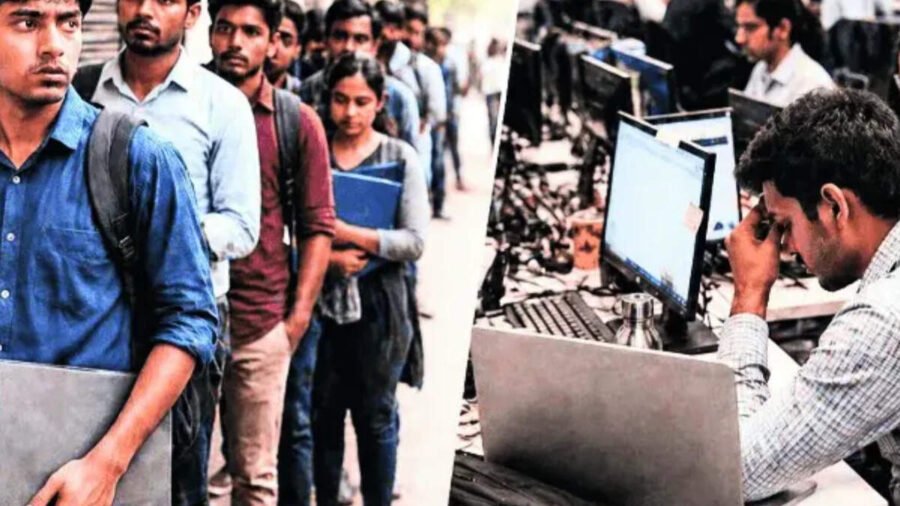
Recent student-led protests over exam paper leaks and scarce jobs are not only about administrative failure. They reveal an economy in which too many educated young people are competing for too few routes to work that offer status, security and mobility.
It is not that jobs are not being created. Between 2018-19 and 2025, the share of working-age Indians in employment rose from 47% to 56.2%, adding an estimated 104 mn workers. But more than 40 mn entered agriculture, almost entirely as self-employed – the reverse of the shift out of low-productivity farming that normally accompanies structural transformation. Services added the most jobs outside agriculture, about 30 mn, though these include both aspirational, formal, high-paying work and low-paid, informal work.
Jobs that are missing sit in the middle. Among wage workers, employment growth over the past 7 years was strongest at the bottom of the skill distribution, moderate at the top and weakest in the middle. Mining and construction labourers increased by about 14.8 mn, and cleaners, helpers and food-preparation assistants by 47 lakh.
- India must create productive non-farm work at scale, including in labour-intensive manufacturing, construction, logistics, health, hospitality and trade. Because low-skill manual jobs will remain important, policy must also raise their productivity and quality through better infrastructure, formal contracts, access to credit and social protection.
- India should expand activities in which tech creates complementary middle-skill work. Rooftop solar and EV charging require electricians, installers and maintenance technicians. Automated factories need machine operators, quality-control staff and repair technicians. An expanding health system needs nurses and lab technicians, even when AI can assist diagnosis.
- 'AI skilling' cannot be a single course appended to every programme. Training must be occupation- and task-specific – how an accountant verifies AI-generated analysis, a nurse uses decision-support tools, or a sales worker complements automated insights with human judgement.
(Disclaimer: The opinions expressed in this column are that of the writer. The facts and opinions expressed here do not reflect the views of www.economictimes.com.)
Add 

(Catch all the Business News, Breaking News, and Latest News Updates on The .)
…more
Elevate your knowledge and leadership skills at a cost cheaper than your daily tea.
-
The Nifty doesn't predict India. It records it -
ET Prime special series: Bigger or Better? Bharat Electronics’ 2013 to 2026 journey – Part 2 -
Will Uncle Sam’s 100% tariff threat stop India’s Russian oil imports? -
ET Prime special series: Bigger or Better? Bharat Electronics’ 2013 to 2026 journey – Part 1 -
Stuck for a decade, then 5 years early: Can biogas follow ethanol's curve? -
Rupee is stabilising, but another currency risk is staring at India Inc -
AI is powering US GDP: Why India cannot afford to be left behind -
The umbrella seller as economic forecaster -
How Future Consumer insolvency professional selection slipped from SBI’s control -
Bigger or Better: Tata Power – the hard part is done. Will the paying part start? Part 3

Octopus Energy pays UK homes £100m for solar power
By Sohail Khan · 16 Aug
James Dole’s failed coffee plan made him king
By Sohail Khan · 16 Aug
Ronaldo says ‘probably’ in last year of his career
By Sohail Khan · 16 Aug
Leave a Reply