How China’s ‘worst animated film’ Niu Lai became unlikely rival to The Odyssey, Spider-Man
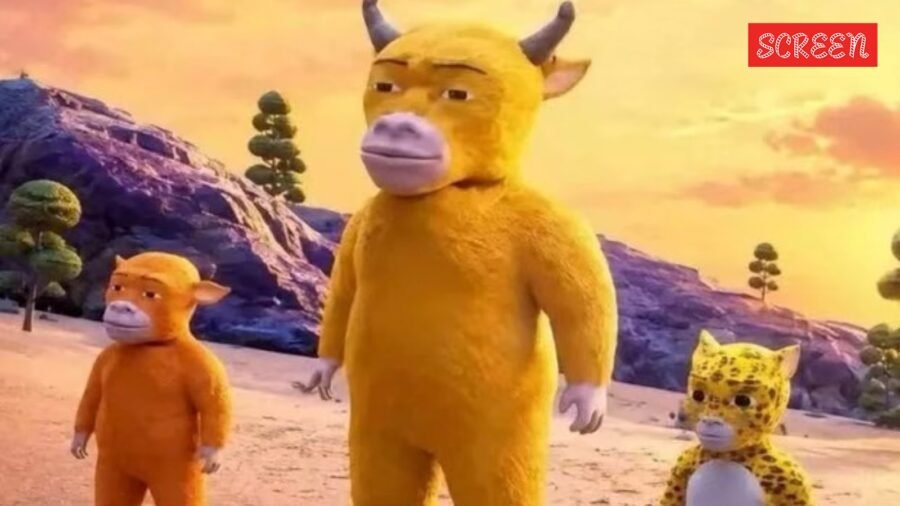
Niu Lai may be the strangest box-office story to emerge from China this summer. An obscure, low-budget animated film that opened with barely any audience has suddenly become a theatrical sensation — not because viewers were convinced it was good, but because the internet convinced them it was spectacularly bad.
The 86-minute film, whose title has been translated as The Cow Is Coming or Here Comes the Cow, follows a newborn calf through a surreal story of growing up, family, love and sacrifice. Its crude 3D models, jerky movements, awkward dialogue and bizarre sound effects have made it an easy target online. But the mockery soon became curiosity, and curiosity became ticket sales.
That has put Niu Lai in the unlikely position of giving major Hollywood releases such as Christopher Nolan’s The Odyssey and Spider-Man: Brand New Day competition at the Chinese box office. While it remains far behind both films in cumulative earnings, there have been days when the low-budget animation has surpassed them in daily collections, an extraordinary turnaround for a film that initially appeared destined to disappear.
From a box-office flop to a viral hit
Niu Lai was released on August 5 with virtually no conventional publicity. There was no trailer, promotional tour or significant pre-release campaign. The film earned only about 10,000 yuan in its first 10 days, with some days taking in as little as 200 yuan, according to Maoyan, the Chinese movie-tracking platform.
Then social media discovered the film.
Clips and screenshots mocking its animation and bewildering storyline began circulating online. Instead of killing the film, the ridicule created a new reason to watch it: audiences wanted to see for themselves whether it really was as strange as everyone claimed.
The turnaround was dramatic. Maoyan’s figures put the film’s total box office at 17.1 million yuan ($2.5 million), after it took in 8.2 million yuan in a single day and recorded nearly 300,000 admissions that day.
Cinemas began adding screenings as demand grew. Some did not even have official promotional artwork, so staff created their own. The Associated Press reported that cinema posters included a hand-drawn calf alongside the slogans, “Come on over if you’re into the bizarre” and “No refunds.”
Story continues below this ad
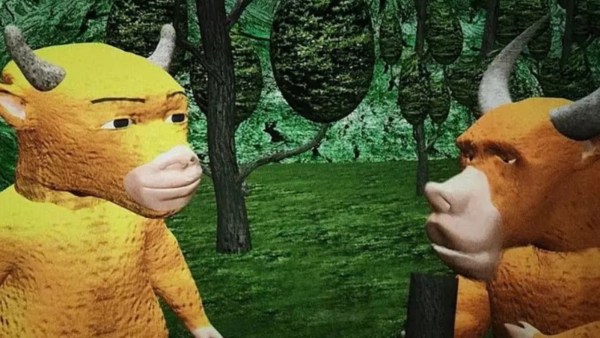 A still from Niu Lai.
The mother-son team behind Niu Lai
The story becomes even more unusual when you look at how Niu Lai was made.
Red Star News, a local news website, reported that the film was produced over five years by director Xin Yumeng and his mother, Sun Lifang, with Xin handling the animation and his mother working on the screenplay and voices.
Xin had previously worked in interior design and had no formal filmmaking training, according to The Independent. He used his experience in spatial design to approach animation, explaining: “It’s all about building things up, only we used to use bricks, now we use polygons”.
Story continues below this ad
The production was essentially a DIY operation. Xin handled modelling, rigging, animation, lighting, rendering and editing himself, while much of the equipment consisted of second-hand computers.
The film’s reported production budget was only 20,000–30,000 yuan.
‘I chose to let the story run first’
Xin has defended the film’s rough appearance by arguing that visual perfection was never the priority.
“If we focused all our energy on rendering precision, this film would never have been made. Between perceiving details and the overall narrative, I chose to let the story run first,” he said in a radio interview for Entrepreneurial Youth Talk.
He also rejected the idea that the film’s sudden popularity was the result of a carefully engineered publicity stunt.
Story continues below this ad
“There’s nothing to market, I don’t even have the money for marketing,” he said.
Why are people actually watching it?
The answer is not simply that Niu Lai is “so bad it’s good”.
For some viewers, the attraction is the prank. The Associated Press spoke to 19-year-old Shanghai college student Du Mingxi, who said his initial intention was to trick his friends into watching it.
“My initial intention has always been to play pranks on my friends,” Du said.
Story continues below this ad
He persuaded two friends to watch the film with him. Both found it entertaining, although one eventually fell asleep.
“They are just the same, it is funny but hard to describe what’s funny about it, and young people just love spreading these memes virally,” Du said.
On Douban, another popular Chinese film-review platform, reactions ranged from “unbelievably terrible and eye-opening” to “a symbol of the new internet troll culture.” Some viewers recommended it specifically because they wanted to experience the film everyone was talking about.
But there are also people who see something endearing in its limitations.
Story continues below this ad
Zhong Jiaming, a vocational schoolteacher in Guangzhou, told the AP that the film offered a contrast to technically polished movies whose stories sometimes fail to connect.
“This is a movie for the young at heart,” Zhong said, adding, “It is simple and honest, like a bedtime story for children.”
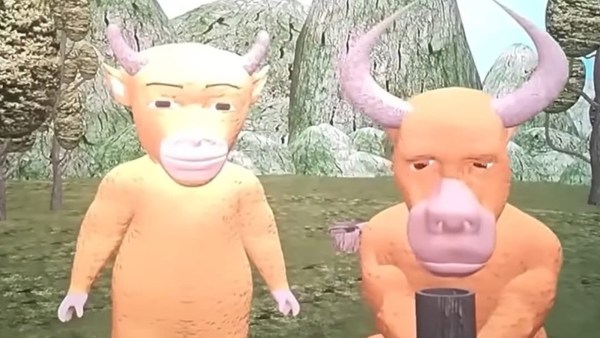 A still from Niu Lai.
When the industry says enough is enough
The film’s success has not been universally welcomed.
A commentary published by the state-owned Beijing News warned that cinemas risked “losing the trust” of viewers if they continued to “lower their standard” by giving Niu Lai more screenings.
Story continues below this ad
It urged cinemas to “act as gatekeepers for the audience” and reject films that were “obviously not up to standard.”
An anonymous film industry professional quoted by The Guardian described Niu Lai as “bad in every aspect imaginable, including the story, special effects and almost every element that a movie is expected to have.” The professional said its success “feels like an embarrassment to the Chinese film industry.”
And yet the criticism has not stopped people buying tickets. If anything, the controversy has given audiences another reason to find out what the fuss is about.
The Niu Lai phenomenon
Christopher Nolan’s The Odyssey arrived in China with enormous international attention and a major studio behind it. Niu Lai arrived with almost no publicity, a tiny production team and hand-drawn cinema posters.
Story continues below this ad
Yet the internet gave the little film something money cannot easily buy: curiosity.
People wanted to see the film because their friends had told them it was terrible. Then they wanted to share their own reactions. More people saw those reactions, became curious and bought tickets. The cycle repeated.
That is how mockery became word of mouth, word of mouth became a meme, and the meme became box office — turning a five-year, mother-son passion project made with little money and almost no publicity into one of China’s most unlikely cinematic talking points of the summer.

Karthik Subbaraj dismisses ‘Boycott Dorothy’ calls: ‘There’s online hate, audience likes it’
By Sohail Khan · 28 Sep
MP content creator Nidhi Tiwari dies by suicide at 30; last post leaves followers emotional
By Sohail Khan · 28 Sep