Health insurance claim denied? Here are 3 important ways you can avoid rejection

Careful disclosure, policy checks and understanding hospitalisation rules can help health insurance buyers avoid rejected claims and out-of-pocket costs.
Updated on: Aug 19, 2026, 10:19:44 IST
Prefer HTon Google
Share via
Copy link
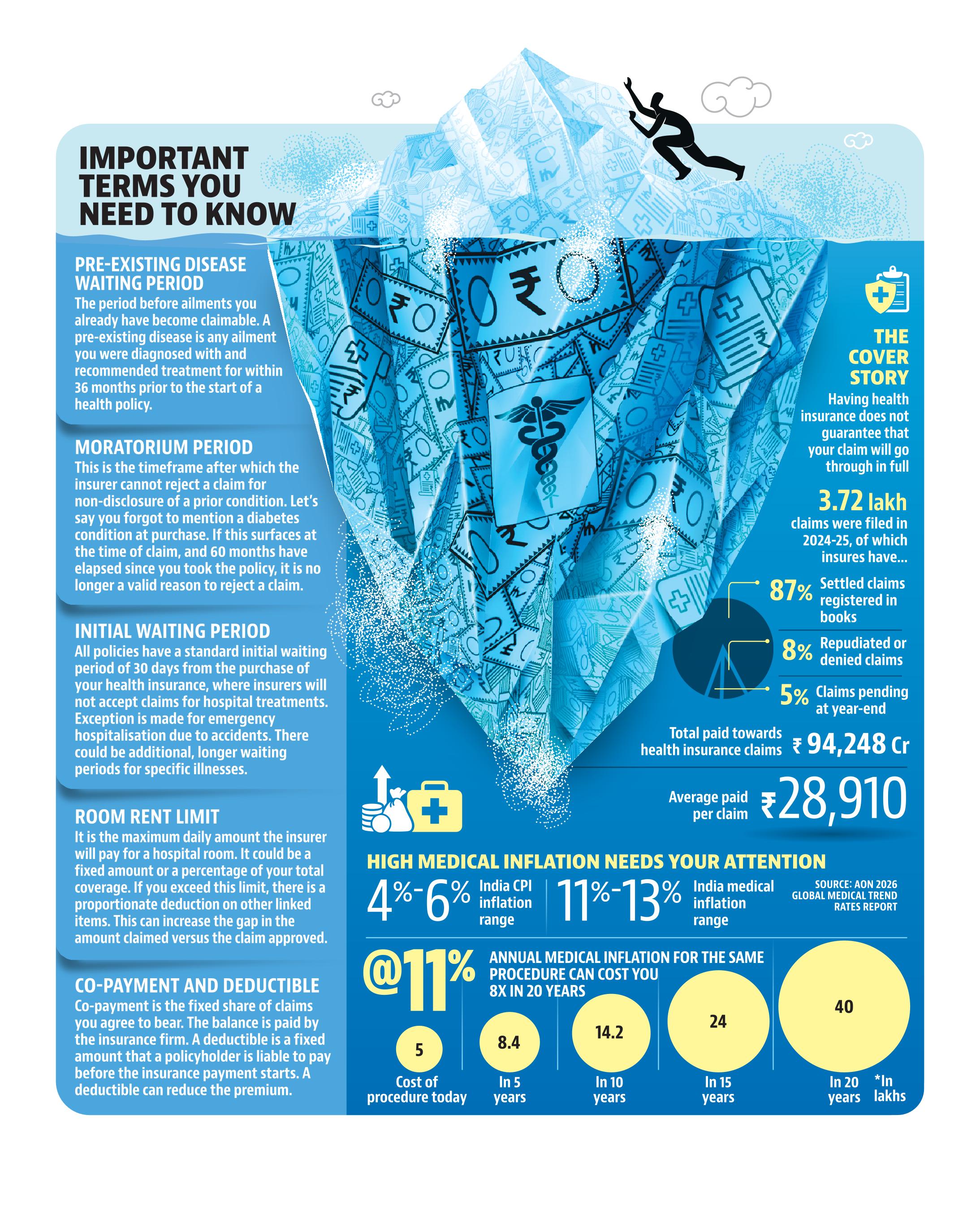
You’ve bought health insurance. But getting the policy is only the first step. IRDAI data shows that roughly one in every four rupees claimed from health insurers in 2024-25 was not paid, either because the claim was disallowed or repudiated.
If the first step is getting adequate health cover, the second is making sure you fill in the proposal form carefully and understand the policy conditions. These steps can reduce the risk of a claim being rejected or the eventual payout falling short of the hospital bill.
Insurance can be complicated, but there are several things within your control. The most important are choosing the right product and insurer, providing complete and accurate information when buying the policy, and understanding what the policy does (and does not) cover.
A comprehensive policy from an insurer with a strong claims record is a good starting point. But even the right policy may not pay the full hospital bill, with minimal out-of-pocket expenses, unless you get three things right.
1. Declaring pre-existing conditions
Not disclosing pre-existing conditions accurately in the proposal form can create problems later. If you are admitted for a planned treatment or surgery related to a pre-existing condition that you did not disclose, the insurer may reject the claim.
Even in an emergency, doctors and nurses may ask you and your accompanying relative detailed questions about your health history and current habits. That is when discrepancies between what was disclosed when the policy was bought and what emerges during treatment can become an issue.
Puneet Oberoi, CEO, Finwise Services Pvt Ltd, said: “People think that hypertension or diabetes are normal and skip adding these details while filling up the health insurance application. Or maybe the advisor or agent is over enthusiastic to get the policy through and doesn’t probe for details. It may happen that you buy the policy directly and get careless or are in a hurry. Be it intentional or otherwise, missing disclosures are grounds for rejecting a claim.”
For insurers, non-disclosure of material facts relating to previous illnesses, hospitalisation or lifestyle factors affecting health can be significant when assessing a claim.
Mahavir Chopra, CEO and founder, Beshak.org, said: “This kind of miss often happens while getting health cover remotely for parents. You pay a high premium for age, but without diligence in filling the proposal form, the entire effort and money may go to waste.”
2. Misrepresentation or overcharging
What also matters are the facts surrounding the medical event that led to the hospitalisation.
Oberoi said there have been cases where doctors recommend hospitalisation for relatively minor conditions and hospitals accept patients because of the financial incentive involved. “However, the insurance company is within its rights to reject a claim that does not find merit in terms of the insured needing to be hospitalised in the first place,” he said.
For example, a fever caused by non-specific factors may not necessarily warrant hospitalisation from an insurer’s perspective.
The cost of treatment can also affect the amount ultimately paid.
“There have been cases where hospitals routinely overcharge for a procedure knowing that it will be covered by insurance. If the insurer assesses the final claim to be too high relative to the average cost of the same procedure in other similar hospitals, the chances are that the entire claim will not go through and the customer may get a lower amount against their original invoice,” Chopra said.
If an insurer has doubts about a claim, a cashless request may not be approved immediately. The insurer may first examine the circumstances and supporting documents before deciding how to proceed.
As a customer, therefore, it is important not only to be accurate about your medical history but also to understand the circumstances and costs of a planned hospitalisation. Before an illness-related procedure or surgery, get a cost estimate from the hospital and, where appropriate, seek independent medical opinions on the proposed treatment and its cost.
3. Policy conditions
Another source of a mismatch between the hospital bill and the amount paid by an insurer is the policy’s conditions and limits.
Room-rent caps are one such condition. If a policy caps room rent at ₹5,000 and you choose a ₹10,000 room, the impact may extend beyond the room charge itself. Depending on the policy terms, the insurer may apply a proportionate deduction to other associated expenses, such as surgeon’s fees, nursing and diagnostics.
For example, if a policy applies a 50% proportionate deduction because the room chosen costs twice the permitted amount, a ₹4 lakh eligible bill could effectively result in a ₹2 lakh settlement.
Other policies may have limits on particular surgeries or treatments. Unless you understand these conditions before buying the policy, you could face a lower payout when you make a claim.
Experts recommend looking for policies without room-rent caps or treatment-specific limits where possible.
A cashless policy also does not mean instant claim approval. Hospitals have their own discharge procedures, while insurers have verification processes, which can mean that discharge takes time. Before buying a policy, read the fine print carefully. Pay particular attention to key terms and conditions, waiting periods for illnesses and maternity, exclusions and the insurer’s hospital network.
Don’t dismiss the help you may need
In 2024-25, total claims under the health insurance business of general and health insurers stood at ₹1,32,487 crore, up 13% from the previous year. Of this, ₹94,248 crore was paid, ₹18,521 crore was disallowed and ₹11,412 crore was repudiated or denied.
There is considerable fine print to understand before buying health insurance. Disputed claims can take time to resolve and can have significant financial consequences.
If navigating the proposal form and policy terms yourself is too time-consuming, consider taking help from a qualified insurance adviser who can guide you through the application process and assist with claims. The rigour applied at these two stages—buying the policy and making a claim—can make the biggest difference to the outcome.
See Less

UN backs PM Modi’s UNSC reform push
By Sohail Khan · 12 Sep
Air India pilot found dead in Delhi hotel
By Sohail Khan · 12 Sep
El Nino puts Atlantic hurricanes on mute
By Sohail Khan · 12 Sep