Gandak surge eases; Bihar embankments withstand after Nepal upstream floods
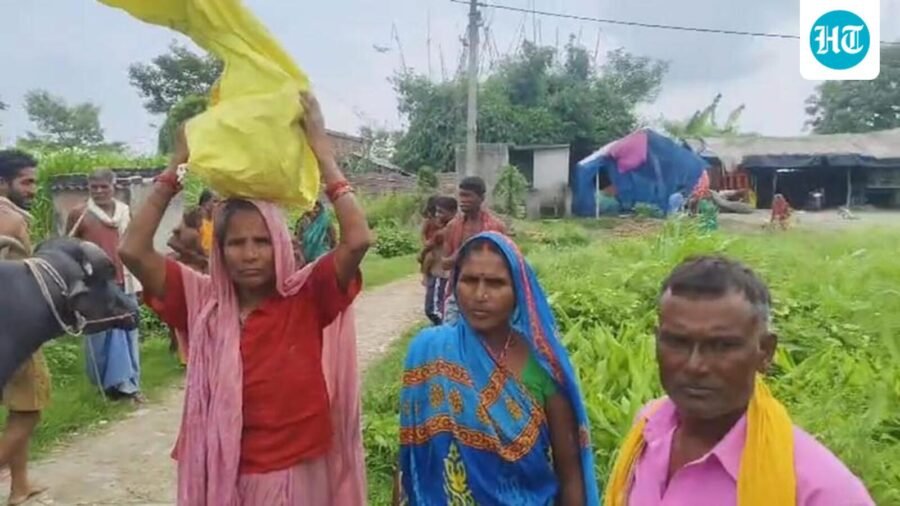
Floods washed away roads, bridges, houses, and power projects, killing 160 people and leaving at least 750 others unaccounted for in Nepal
Published on: Aug 27, 2026, 09:39:13 IST
Prefer HTon Google
Share via
Copy link
The surge in the Gandak River waters triggered by upstream flash floods in Nepal and Tibet receded overnight, even as over 4,000 people were evacuated from parts of Bihar around midnight on Thursday. Officials allayed fears, saying embankments withstood the pressure and water levels were returning to normal.
The Valmiki Nagar barrage in West Champaran recorded its highest discharge of around 1.50 lakh cusec around midnight. By early morning, the flow had stabilised. At about 7am, the discharge was at 95,200 cusec. It receded to around 88,000 cusec by 8 am, said Bihar water resources department secretary Chandra Shekhar Singh.
“Excess water passed off the river Gandak. Embankments of the river sustained the pressure, and everything passed off well. We kept monitoring the embankments throughout the night. There was no damage to the embankments,” Singh said.
Deep Dive
Powered ByAsk
Water resources department officials said there could be a marginal rise of 1-2 cm in the Ganga water levels at Gandhi Ghat in Patna. The Ganga and Gandak rivers meet at Harihar Nath Kshetra in Saran district, opposite the ghat.
Authorities sounded a high alert across Bihar’s north-western districts following floods in the Bhote Koshi into Nepal’s Trishuli-Narayani system, which feeds the Gandak.
Officials had flagged the possibility of a surge of up to 2-3 lakh cusec reaching the Valmiki Nagar barrage. All 36 gates of the barrage (with a capacity of 8.5 lakh cusec) were opened in phases as a precaution. Technical teams were deployed for round-the-clock monitoring.
Chief minister Samrat Choudhary convened a review meeting and formed a committee under the chief secretary and police chief. Deputy chief minister Vijay Kumar Chaudhary urged people to remain alert yet calm.
National Disaster Response Force (NDRF) and State Disaster Response Force (SDRF) teams were rushed to vulnerable districts including West Champaran, Gopalganj and Muzaffarpur.
Authorities reiterated appeals to ignore rumours and rely on official advisories. They asked people to follow any evacuation instructions, particularly in embankment-adjacent areas. Officials carried out night patrols, stockpiled relief materials, and prepared boats and shelters as part of their preparedness.
Bagaha-2 circle officer Wasim Akram said 1,500 people were evacuated from low-lying areas in Jhandu Tola, Bin Toli and Chakdahwa to safer places. “About 250 have taken shelter in Utkramit Madhyamik Vidyalay, Bherihari colony,” said Gulab Ansari, a resident of Chakdahwa.
The West Champaran district administration released a video showing the community kitchens at Bherihari colony, Yogapatti and Bairiya.
Bettiah sub-divisional magistrate Vikash Kumar said 700 were evacuated in Yogapatti, 250 in Bairiya, and 70 in Nautan block (West Champaran). Over 250 people had to be evacuated in Piprasi block in Bagaha 1 block.
Floods washed away roads, bridges, houses, and power projects, killing 160 people and leaving at least 750 others unaccounted for after ice, mud, and rocks collapsed into a Himalayan river at the Nepal-China border near Tibet on Wednesday morning.
As many as 133 Indians and 37 non-resident Indians were among foreigners unaccounted for. Most of them were on the Kailash Mansarovar Yatra pilgrimage. At least 37 of them are from Tamil Nadu. The death toll was feared to rise.
On Wednesday, officials sounded a high alert across seven districts in Bihar and Uttar Pradesh as water levels were expected to surge in the Gandak, Ghaghara, Rapti and Kosi rivers.
See Less

CEC Gyanesh Kumar postpones 2-day Chhattisgarh visit
By Sohail Khan · 7 Oct
Kilmar Ábrego Garcia is set to be back in court as he battles deportation to Liberia
By Sohail Khan · 7 Oct
Former German spy chief arrested for attempted treason, obtaining state secrets
By Sohail Khan · 7 Oct