Five women, zero arcs: Yash’s Toxic promised a voice for women, fails each one of them
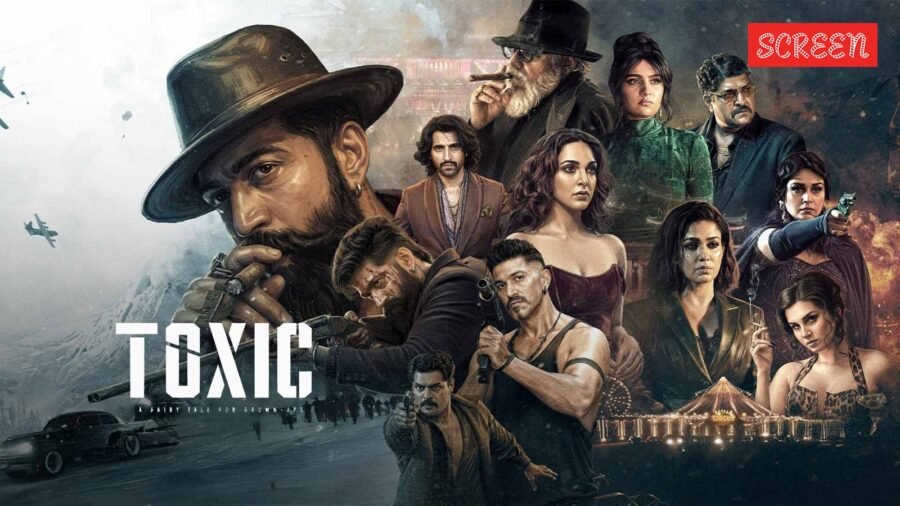
I want to be fair to Toxic. The film has a female director in Geetu Mohandas, who built her reputation on the quiet and complex Mothoon and Liar’s Dice. It has five women in its cast, all of them established, all of them talented, all of them capable of carrying a film on their own. Its leading man stood on a stage in Hyderabad a few days before release and told a crowd of young women to not go by the film’s teaser and trailer, one of which had Yash decimating female assassins dressed in spandex. Toxic will subvert the male gaze, the star hinted and asked women to trust and watch the film.
And I watched, like many others did. While I looked for the voice, all I found was five women who enter, serve and exit a man’s story. I found trauma used as a plot device. I found love used as a power transaction. I found one sister whose entire identity is her brother. I found one lover whose emotional depth exists only to complicate the hero’s arc. I found one conquest who is discarded when someone better arrives. I found one attachment the script does not even bother to explain. And I found one secret that arrives too late to matter.
I realised the five women had only one function: Make the man feel something so his story can move forward. When it does, they are no longer needed.
Story continues below this ad
Toxic ending explained: Yash film hides a dark, bloody secret in Raya vs Ticket showdown
This is not a review of Toxic. Enough reviews exist. This is about one specific question: does the film keep its promise to its women?
Let’s start with what was said. At the Toxic pre-release event at Malla Reddy University in Hyderabad, Yash addressed the women in the crowd directly. “This film’s director is also a woman,” he said. “For us men, to achieve something in life, it is one level of effort. For women, it is double. Society may not accept it. But everybody will look down upon you.” He then said, “The director will prove that every girl, every woman can face every kind of situation and express their thought and express their vision and succeed in this society. There is a voice for women in this film, unlike how it is coming across in the trailer.”
Kiara Advani, speaking at the same event, credited Mohandas entirely for her character Nadia. “If it was not for Geetu, I don’t think we would have been able to bring this to life. She saw it in me and really gave me wings to fly,” she said. Huma Qureshi said the film would be “remembered for a very, very long time.” Rukmini Vasanth called working with Yash “a bucket list moment.”
Story continues below this ad
What Toxic actually does
It is not different, or not where it matters. Toxic has five female characters. Each one is played by a genuinely talented actress. Each one delivers committed, sometimes excellent work with the material she is given. And each one exists, from first scene to last, in relation to one man: Raya, played by Yash.
This is not a reading I am imposing on the film. Every woman enters the story when Raya’s arc requires her. Every woman exits when her utility to his journey is exhausted. No woman has a storyline that exists independently of what she means to him, provides for him or suffers because of him.
Nayanthara plays Ganga, Raya’s elder sister. On paper, she is the strongest female character in the film. She raised Raya after their mother abandoned them. She is the strategic mind behind his rise and is fierce, protective and driven. She is also, from beginning to end, defined entirely by one relationship — her brother.
Ganga does not want anything for herself. She does not have friends, lovers, doubts or ambitions that are not about Raya. Her single goal in life is to make him the king of Goa’s underworld. When he succeeds, she is fulfilled. When he is threatened, she fights. When he makes choices she disagrees with, she pushes back, but only because those choices affect his trajectory, not because she has an independent perspective on life. The answer is: she exists so that Raya has someone to come home to.
Story continues below this ad
Kiara Advani’s Nadia is, by the most, the film’s best female character. But here is the thing about Nadia’s trauma — her pain does not exist so that she can overcome it; it leads to a crisis so that Raya must resolve it.
Tara Sutaria plays Rebecca, the daughter of mob boss Salvador. She has a fling with Raya, and ends up falling for him. The entire empire is given on a platter to Raya, and Rebecca’s hand in marriage. However, he falls in love with Nadia. Rebecca’s narrative function is to be the woman Raya outgrows, a stepping stone on his emotional journey as she goes from a casual conquest to something resembling genuine feeling.
Rukmini Vasanth plays Mellisa, who enters the film late and provides Raya with emotional warmth during a stretch where he needs it. But audience who watch the movie had one lingering question: “Why does she fall for Raya? What is the reason?”
Story continues below this ad
 Kiara Advani as Nadia in Toxic.
The film does not bother with an answer because, within its logic, the answer is obvious. She falls for Raya because he is Raya. He is the hero. The idea that a woman might need a reason, a motivation, a story of her own before she is drawn to the male lead does not appear to have occurred to the screenplay.
Huma Qureshi’s Elizabeth was kept out of the promotional campaign entirely. At the Hyderabad event, Huma said, “There is a reason they have decided not to reveal too much about my character.” The implication was that Elizabeth carries a narrative twist worth protecting.
The problem is that by the time Elizabeth’s significance becomes clear, the film is already one hour deep, overstuffed with characters and running out of runway. By the time we understand her arc as a character, she is lying dead in the arms of Raya.
What did Geetu Mohandas change?
This is the part that is hardest to write. When Yash came together with a Geetu Mohandas for a film called Toxic, subversion wasn’t only expected, it was guaranteed. Ram Gopal Varma called her “the ultimate symbol of women empowerment” based on the trailer alone.
Story continues below this ad
Toxic, however, suggests that having a woman direct a star vehicle does not automatically produce well-written female characters if the star who co-wrote the screenplay is the gravitational centre of every scene. And that screenplay makes one thing clear: Raya’s story is the only story. Everyone else, male or female, is there to serve it. The women just happen to serve it more visibly and at greater personal cost.
Toxic is not the first Indian gangster film to treat its women as extensions of the male protagonist. It is not even the worst offender. Every gangster film in every language has this problem to some degree. The genre is built around male power fantasies, and women in these stories have historically existed to humanise, motivate or mourn the men at the centre.
The reason Toxic deserves scrutiny is because it reneged on its promise to be better. It positioned itself as the gangster film that finally treats its women as people rather than plot devices.
It did not deliver on that promise. The women of Toxic are better dressed, better lit and given more dialogue than the women in most Indian action films. But better presentation is not the same thing as better writing. A longer leash is still a leash.