‘Fake’ Ram Mandir prasad on Amazon, fined
Benchmarks
Nifty24,213.20134.91
FEATURED FUNDS★★★★★
Motilal Oswal Midcap Fund Direct-Growth
5Y Return
23.26 %
Invest Now
Enter search text:
Business News›News›Trending›Ladoos, pedas sold as Ayodhya Ram Mandir Prasad found fake: Consumer body fines Amazon for misleading ads; says devotees' religious sentiments exploited
Read Today's Paper
Ladoos, pedas sold as Ayodhya Ram Mandir Prasad found fake: Consumer body fines Amazon for misleading ads; says devotees' religious sentiments exploited
Synopsis
Ladoos, pedas, and other sweets sold on Amazon as Ayodhya Ram Mandir Prasad without any temple authorisation have landed the e-commerce giant with a Rs 1 lakh penalty from India's Central Consumer Protection Authority. The CCPA found that Amazon's platform lent legitimacy to the misleading listings and that the listings exploited the religious sentiments of devotees, particularly in the days leading up to the historic Pran Pratishtha ceremony in January 2024.
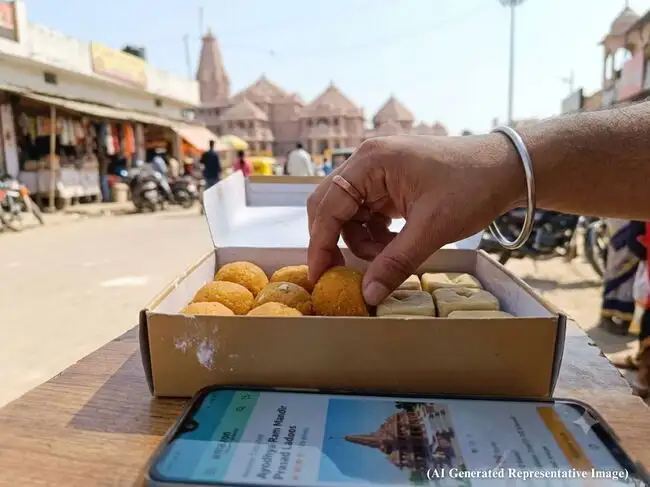
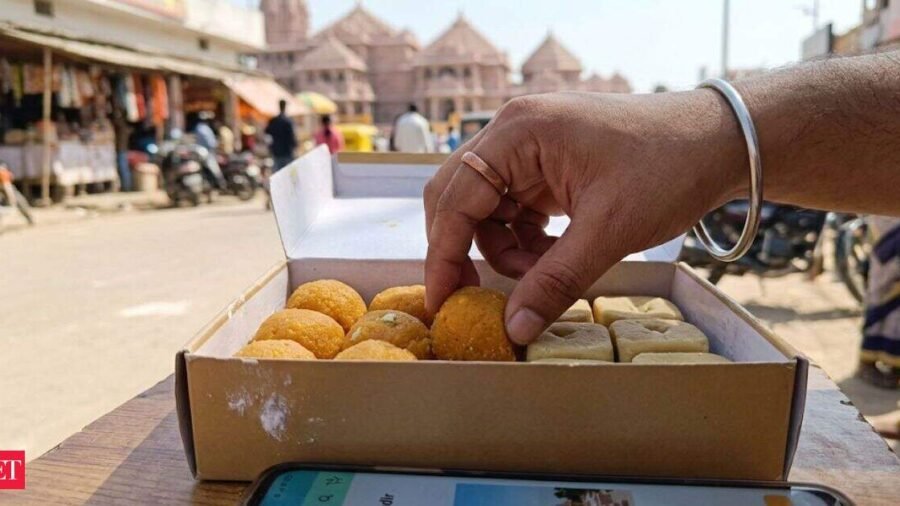
Ladoos, pedas sold as Ayodhya Ram Mandir Prasad found fake: Consumer body fines Amazon.
Ladoos, pedas, and other commercially manufactured sweets listed and sold on Amazon as authentic Ayodhya Ram Mandir Prasad have drawn a Rs 1 lakh penalty on the e-commerce company from the Central Consumer Protection Authority, which found that the listings exploited the religious sentiments of devotees and that Amazon's platform lent them an unwarranted air of legitimacy.
The CCPA passed its final order on 4 August 2026, nearly two and a half years after the matter first came to light in January 2024, days before the historic Pran Pratishtha consecration ceremony of the Shri Ram Mandir in Ayodhya.
Also read: Tanker driver fills 9,800 litres of milk after delivering paneer whey; dairy plant catches the vehicle with Rs 7.6 lakh worth 'stolen' load; security guard accused for helping gets bail
What Was Being Sold as Ram Mandir Prasad on Amazon?
The products at the centre of the case were four sweet items listed on Amazon by a Patna-based seller, M/s Chandu Trading Company, under the brand Bihar Brothers. All four bore product titles prominently using the phrase Shri Ram Mandir Ayodhya Prasad or Ayodhya Ram Mandir Ayodhya Prasad and were available for nationwide delivery under Amazon's Grocery and Gourmet Foods category.
The products were a ghee ladoo priced at Rs 299, a khoya ladoo at Rs 350, a ghee bundi ladoo at Rs 350, and a desi cow milk peda at Rs 385. All were listed as 250-gram packs.
The listings used religious imagery, Hindi slogans referencing Lord Ram and Ayodhya, and marketing language asserting that the products carried blessings from Shree Ram Janam Bhumi Temple, Ayodhya. In the ingredient column of all four listings, the ingredient was simply described as Ram Mandir Prasad, which the CCPA called a patently misleading and non-factual description of actual contents.
None of the products had any authorisation, affiliation, or endorsement from the Shri Ram Janmabhoomi Teerth Kshetra Trust, which manages the temple.
How Did the Case Against Amazon Begin?
The Confederation of All India Traders flagged the listings to the Union Minister for Commerce and Consumer Affairs in January 2024. The complaint was forwarded to the CCPA, which took immediate cognisance and issued a show cause notice to Amazon Seller Services Private Limited on 19 January 2024, just three days before the Pran Pratishtha ceremony on 22 January 2024.
The CCPA noted that the listings went live on one of India's most visited e-commerce platforms at the precise moment when crores of devotees, unable to travel to Ayodhya physically, were seeking prasad through online means. The authority observed that an average consumer on Amazon does not scrutinise the identity of individual sellers but reposes trust in the platform itself, meaning the listings carried an inherent legitimacy simply by appearing on Amazon.
Did Amazon Exploit Religious Sentiments of Devotees?
The CCPA was explicit on this point. It observed that the phrase Shri Ram Mandir Ayodhya Prasad carries a specific and well-understood meaning for Hindu devotees, denoting sacred food offered to and blessed by the deity at the Ram Mandir. The commercial appropriation of this phrase for ordinary confectionery, without temple authorisation, the authority said, constitutes not just a misleading trade practice but an affront to the religious sentiments of crores of consumers.
The authority further noted that the timing of the listings, just before the Pran Pratishtha ceremony, made devout Hindu consumers a particularly vulnerable class who were especially susceptible to being misled.
What Was Amazon's Defence?
Amazon argued throughout the proceedings that it operates purely as a marketplace intermediary and plays no role in listing, pricing, or describing products, all of which are managed exclusively by third-party sellers. The company claimed safe harbour protection under Section 79 of the Information Technology Act and relied on the Supreme Court's Shreya Singhal judgment to argue that intermediaries are not obligated to pre-screen content and that actual knowledge of a violation arises only through court orders.
Amazon also submitted that all sellers are contractually bound under its Business Solutions Agreement to comply with applicable laws, and that upon receiving the show cause notice it promptly took down all four listings and disclosed the seller's identity to the authority.
On the revenue question, Amazon clarified that while the gross merchandise sales generated through the impugned listings amounted to Rs 25,26,309, this represented the seller's total sales across all listings, not Amazon's income. Amazon's own service fee from the four specific impugned listings amounted to Rs 15,165.90.
Can Amazon Hide Behind Safe Harbour in Consumer Cases?
The CCPA rejected Amazon's safe harbour defence in unambiguous terms, and the ruling on this point carries significance beyond this case alone.
The authority held that the Consumer Protection E-Commerce Rules, 2020 and the IT Act operate on distinct legal planes and are not mutually exclusive. A marketplace entity, it said, cannot selectively invoke its intermediary status under the IT Act to escape consumer protection obligations while simultaneously deriving commercial benefit from transactions on its platform.
The CCPA held that the E-Commerce Rules mandate affirmative, proactive, and continuous obligations on marketplace entities, not merely reactive ones triggered by court orders or specific complaints. Rule 4(3) of those rules casts an absolute and standing prohibition on unfair trade practices on e-commerce platforms, irrespective of whether the platform had prior knowledge of a specific violation.
The authority stated that statutory duties cannot be contracted away or delegated to third parties through agreements like Amazon's Business Solutions Agreement.
On the question of seller disclosure, the CCPA found that Amazon's practice of making seller details accessible only through a hyperlink, and its grievance mechanism requiring mandatory login, did not satisfy the requirement for clear and accessible disclosure under the E-Commerce Rules.
Amazon's Automated Systems Failed to Catch Fake Ayodhya Prasad Listings
The CCPA noted with particular concern that despite Amazon's claims of operating automated monitoring systems and machine learning algorithms to identify prohibited listings, the impugned products, which used the name of one of the most revered religious institutions in the country in their very product title, remained live on the platform without detection or proactive intervention.
The authority said this demonstrated that Amazon's due diligence mechanisms were either non-functional, inadequate, or not applied to listings of a religious nature, and that a platform of Amazon's scale and technological sophistication is expected to deploy monitoring capabilities commensurate with the sensitivity and potential harm of the content being hosted.
What Has Amazon Been Directed to Do?
After more than two years of proceedings, multiple hearings, and sustained regulatory pressure, Amazon proposed a structured due diligence framework in May 2026. The CCPA has now made implementation of that framework mandatory.
Under the framework, Amazon must ensure that no product falsely claiming to be prasad, prasadam, mahaprasad, bhog, or any similar religious offering associated with ten named religious institutions is listed on its platform without verifiable documentary proof of authorisation from the concerned institution. The ten institutions covered include the Shri Ram Janmabhoomi Mandir, Tirumala Tirupati Devasthanam, Shri Mata Vaishno Devi Shrine, Shri Kashi Vishwanath Temple, Shri Jagannath Temple, Shri Kedarnath Temple, Shri Badrinath Temple, Shri Somnath Temple, Shri Dwarkadhish Temple, and Shri Mahakaleshwar Temple.
Amazon must also prominently display complete seller details including name, address, customer care number, and grievance officer information on its platform at all times, as required under the E-Commerce Rules.
CCPA Penalty on Amazon
The CCPA imposed a penalty of Rs 1 lakh on Amazon under Section 21(4) of the Consumer Protection Act, 2019, for being a party to the publication of misleading advertisements on its platform. The authority noted that it was treating this as a first contravention and applied the penalty at the lower end of the prescribed range, which can go up to Rs 10 lakh, while warning that any future recurrence will invite significantly more stringent action.
Amazon must deposit the penalty within 15 days of the order. The CCPA has reserved the right to review compliance and the effectiveness of the proposed framework after three to four months.
The seller, M/s Chandu Trading Company, did not respond to multiple notices from the CCPA and will face separate proceedings.
Check the CCPA order here:
Add 

(You can now subscribe to our WhatsApp channel)
(You can now subscribe to our WhatsApp channel)
Read More News on
Ayodhya Ram Mandir Prasadfake Ram Mandir PrasadCCPA Amazon penaltyccpa amazon ayodhya prasad orderShri Ram Mandir Ayodhya PrasadAmazon ayodhya ram mandir prasadayodhya ram temple prasad amazonCCPAAyodhya Ram Mandirladoos pedas ram mandir prasad


Enter search text:
Stories you might be interested in

Watch: BRICS’ B’wood twist as Malaysian PM sings
By Sohail Khan · 12 Sep
Beyond bloc politics: BRICS bet on multipolarity
By Sohail Khan · 12 Sep
US teen’s cookie charity raises $66,331
By Sohail Khan · 12 Sep