ExplainSpeaking: The other ‘NEET’ that India policymakers need to address

Dear readers,
Youth protests that forced the resignation of India’s Union Education Minister almost exactly a month ago have not only brought the issue of education into sharp focus, but also highlighted concerns related to unemployment, especially among the youth.
Advertisement
Until now, the government has often cited data on the Unemployment Rate (UER) to suggest that Indians are doing well on the jobs front. The UER is calculated as the number of unemployed people within the total labour force (those currently working or looking for work). To be sure, as Chart 1 shows, official data collected through the Periodic Labour Force Surveys (PLFS) says that the UER has fallen steadily from 6.1% in 2017-18 — hitting a 45-year high — to just 3.1% in 2025.
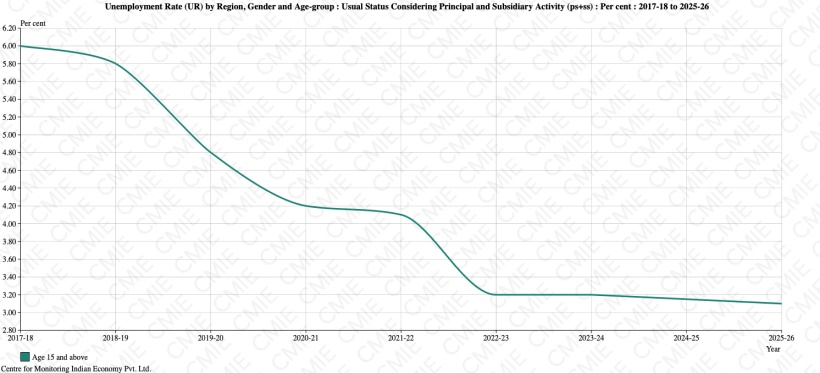 Chart 1
This shows UER for those aged 15 years and above, suggesting that broadly, the Indian economy has been creating jobs and bringing about all-round well-being. However, at least three immediate problems arise if one looks only at the UER, and that too for this age group.
Youth unemployment: Growing worry
The first problem is that the unemployment for the young Indians — those between the ages of 15 and 29 years — is still quite high even though this number has also been coming down. As Chart 2 shows, it has fallen from almost 18% in 2017-18 to around 10% in 2022-23 but has since stayed at this high level.
Advertisement
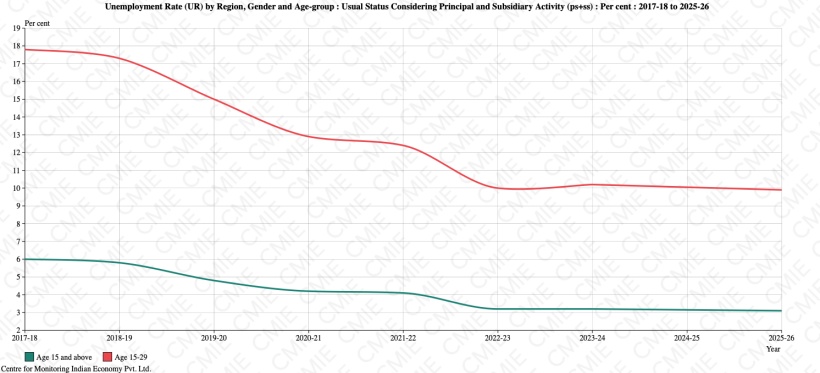 Chart 2
In fact, not only is the unemployment rate highest among the youth as a cohort, it rises with educational attainment. As Table 1 shows, graduates aged 25 face the highest unemployment rate — as high as almost 40%. It means that on average, 4 out of 10 graduates aged 25 years looking for work fail to get it.
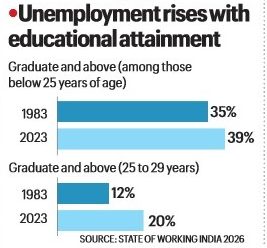 Table 1
The data in this explainer is sourced from the State of Working India (SWI) 2026 report by researchers at the Azim Premji University and the PLFS. They also calculated that the UER among young Indians with education up to graduation or more was actually higher in 2023 than in 1983.
While graduates being unemployed is not a new phenomenon in India, so much so that even movies of yesteryears capture this routine, though crushing reality, the situation seems to be worsening over time.
Quality of jobs, not just quantity
The second problem is that while it is true that more and more jobs have been created since 2017-18, there is a big question mark on the quality of those jobs. Table 2 shows the size of the Indian workforce — the total number of people with a job — over the years. It has increased from 43.3 crore (or 433 million) in 2017-18 to around 61 crore as of December 2025.
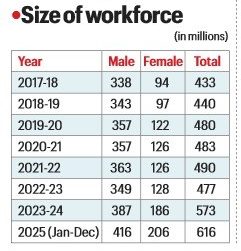 Table 2
But a closer study of the data shows that most new jobs are either in agriculture or in pursuits that pay little or see stagnant earnings growth.
The SWI 2026 pointed out the following: “In the post-Covid period India’s employed population has increased from 490 million to 572 million, with employment rates rising from 71 to 74 percent for men and from 26 to 34 percent for women, between 2021-22 and 2023-24. But the majority of employment creation has been in agriculture. Of the 83 million jobs added between 2021-22 and 2023-24, 40 million have been in agriculture, with women accounting for a large share (38 million).”
Similarly, while women have increasingly joined India’s workforce — rising from 94 million in 2017-18 to 186 million in 2023-24 — as Chart 1 shows, most are involved in work that pays very little. “The number of women in own-account self-employment has seen a nearly four-fold increase since 2017. Self-employment earnings among women and salaried earnings (for men and women) have largely stagnated,” states the report.
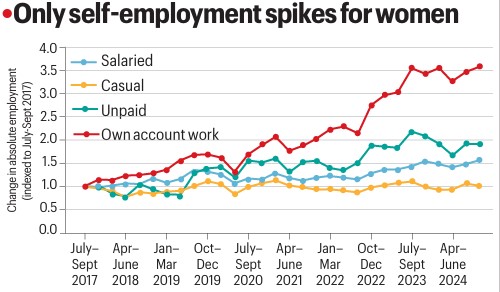 Chart 1
Unemployment rate misleads
Lastly, in a developing economy such as India, using the UER to assess job market stress can be deeply misleading. That’s because the unemployment rate is measured as a percentage of the people demanding a job. While this is a reasonable approach in any economy, in India, there is evidence that not everyone registers in official surveys as people looking for a job. As such, the number of people unemployed is often far more than what the unemployment rate captures.
Rosa Abraham, an associate professor of economics who teaches at APU and is one of the authors of the SWI report, explains, “Unemployment is only measured when you are willing to work and/or searching for a job. But, especially in the case of women (in India), what would happen is that regardless of their education, and even when they have, say, completed graduation, they may not explicitly record or be recorded (in the surveys) as looking for work.” Such women thus get counted out of the “labour force”.
If these people were to be counted as unemployed, they would then be part of the labour force, and the unemployment rate would have been much higher.
“So UER is really the lowest estimate of people who are not being mobilised into the workforce. There is an entire pool of people who are out of the labour force who are either discouraged workers, or there are social norms (often for women) that keep them out of work,” explains Abraham.
The other NEET
Instead of the UER, another metric better captures how the Indian economy is failing its youth. It is called NEET — an acronym for “Not in Employment, Education, or Training”.
Simply put, NEET presumes that many may be pursuing education and, as such, they cannot be expected to join the workforce. So, NEET attempts to understand how many people are not in education or in any training or indeed in any kind of employment.
NEET “is a comprehensive measure of this labour under-utilisation while excluding those in education or training. NEET not only includes the unemployed, but also those who are of working age and are neither in education/training nor employment,” the APU report says.
So, what is the estimate of Indian youth (ages 15 to 29 years) who are part of NEET?
According to official PLFS data released in March this year, 25% of the youth were in NEET.
According to the population projections by the Ministry of Health and Family Welfare used in official calculations, India’s youth population in 2026 is 36.8 crore, making India the country with the largest youth population in the world.
If one applies the same proportion of NEET in 2026 as in 2025, then in 2026, out of a total youth population of 368 million (36.8 crore), around 92 million or 9.2 crore are in NEET.
In other words, as of today, the number of Indian youth who are neither involved in education nor skilling nor any kind of employment is 9.2 crore — that’s almost equal to the total population of Iran.
Apart from the high youth unemployment rate, such a high absolute number of NEET population may explain the growing youth unrest in the country. It is also important to remember that these numbers are at a time when the government is happy with the pace of economic growth based on GDP figures, even calling it a “goldilocks” period.
How do you see the prospects for India’s youth? Do you think something needs to change?
Share your views and queries at udit.misra@expressindia.com
Take care,
Udit

Surveillance is not the only privacy issue
By Sohail Khan · 30 Sep
Silver lining: on the Samarkand Chess Olympiad and India
By Sohail Khan · 29 Sep
State of anticipation: on Jammu and Kashmir and Statehood
By Sohail Khan · 29 Sep