Deepika Padukone endorses post calling out ‘male ego, misogyny’ after Spirit controversy
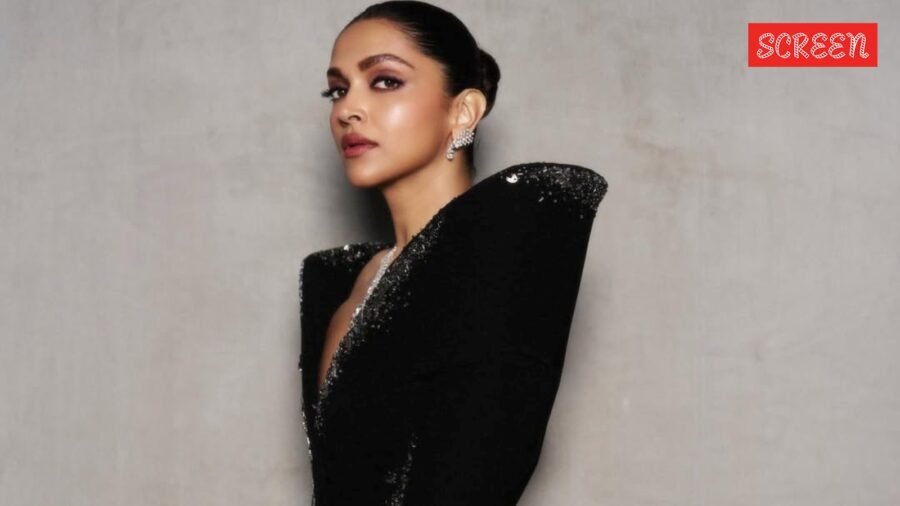
After Sandeep Reddy Vanga’s brother Pranay alleged that actor Deepika Padukone demanded 10 percent of Spirit’s profits during her negotiation, the actor has shared her side of the story, but in a subtle fashion. An Instagram post that called out the “full-blown male-ego” of the makers and the sexism at play in the Spirit controversy was liked by Deepika. While she has not commented on the post, but it seems like Deepika has endorsed the opinion saying that she was seen as ‘difficult’ because she demanded what she believed was right for her, which the men in the film industry have been doing for ages.
Deepika Padukone likes a post criticising ‘male ego’
The post, spread across several slides, read: “Breaking: Deepika Padukone allegedly wanted 10% of Spirit’s profits. Judging by the meltdown, you’d think she asked for the entire film and Vanga estate. Sounds like we have a full-blown male-ego crisis on our hands. A woman rejected a deal, and misogyny couldn’t handle a woman’s no.”
Story continues below this ad
It went on to highlight how profit-sharing models and fixed working hours have been common among male stars for years, adding: “Sandeep Reddy Vanga’s brother Pranay claims Deepika asked for: 10 percent of the profits + her remuneration + an 8-hour workday. And somehow, this is a scandal. But here are some facts: None of this is unprecedented. Male stars have negotiated profit shares, fixed working ours and other favourable working terms for years. A Man does it, he’s ‘disciplined’. A woman does it, she’s ‘difficult’.”
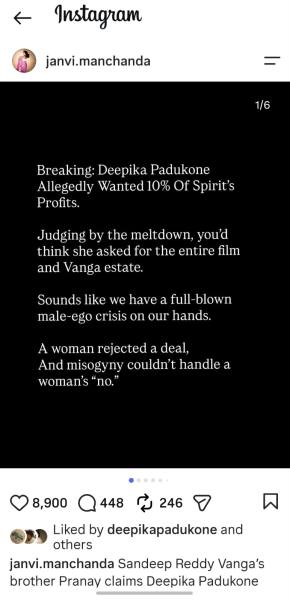 Screenshot of the post liked by Deepika Padukone
While Deepika walked out of the project in May last year, the controversy surrounding her exit has refused to die down, with the issue resurfacing every now and then. The post continued, “Deepika has largely remained silent. Yet months later, the Vanga camp is still talking aboit negotiating her ‘difficult’ terms for 18 months. If the terms didn’t work, they could have simply walked away, and moved on. That’s how negiotiations work. A woman doesn’t have to accept a deal just because a man wants her to.” The post then sarcastically called out the makers and said, “But Deepika made a mistake. She said ‘no’ to a deal that didn’t work for her.”
It further argued that the real issue was not whether Deepika’s demands were excessive, but the fact that she had the power to say “no”. “A woman said no. Some egos got bruised and she’s the problem. The real problem isn’t that she’s ‘too much’, it’s that she had the power to say ‘no’,” the post read and added, “This isn’t about ‘professionalism’. It’s misogyny. It’s sexism. It’s male ego. She said no. Get over it, boys.”
What did Pranay Vanga Reddy say about Deepika Padukone?
Speaking to NTV, Pranay said: “She demanded 10 percent from the film’s profit. Soon after, everything went overboard. See, she can ask for anything. If we are willing to give, we can give. But the economics (budget) should also work out for us. We thought that it was not working. This is why we thought of other options. Once we started looking for other options, they started leaking everything.”
Story continues below this ad
Profit-sharing is a common model among male actors
Over the years, several actors have spoken about working on profit-sharing models. Aamir Khan, for instance, has discussed the model in multiple interviews. Allu Arjun reportedly worked on Pushpa on the condition that he would earn Rs 30 paise for every Rs 1 earned by the film across several platforms, a model that producers have also backed. Such models are frequently followed in Bollywood as well, as many male stars have turned producers and don’t take upfront fees. While working in films that aren’t associated with their own production houses, they often opt for profit-sharing models.
However, ever since Deepika walked out of Spirit, she has faced accusations of sharing the film’s plot, demanding fixed working hours, refusing to do Telugu dialogues and asking for an increase in her fee. The allegations were made not only by Sandeep Reddy Vanga but were also echoed by the makers of Kalki 2898 AD.
When Deepika said her demands are not unfair
Deepika, who remained largely silent on the controversy, said in an interview with Brut last year that she did not believe her demands were “ridiculously unfair”.
Story continues below this ad
She said: “I don’t think what I am asking for is ridiculously unfair and I think only someone who has worked in the system enough will know the conditions that we work in. And I am saying this, if I may say so myself, a top star, so you can only imagine what the working conditions must be like for everyone else, for the crew, for example.”
She added: “I am not the first one who has asked for something like this. In fact, there are a lot of actors, male actors, who have been working on a 8-hour shift for years and it’s never made headlines.” Actor Akshay Kumar is also known for working fixed hours.
When Kalki: 2898 AD makers announced Deepika Padukone’s exit
A few months after walking out of Spirit, Deepika also exited the sequel to Kalki 2898 AD. The makers officially announced her departure, saying: “This is to officially announce that Deepika Padukone will not be a part of upcoming sequel of Kalki 2898 AD. After careful consideration, we have decided to part ways. Despite the long journey of making the first film, we were unable to find a partnership. And a film like Kalki 2898 AD deserves that commitment and much more. We wish her the best with her future works.”
The development further intensified scrutiny of the actor, with the repeated controversies contributing to a perception that she is “difficult to work with.”

‘Why experiment?’: Priyadarshan breaks silence on Haiwaan earning 1/8th of Rs 130 cr budget
By Sohail Khan · 28 Sep