Days after landslide kills 8, Mumbai may use force to clear encroachments, says civic chief
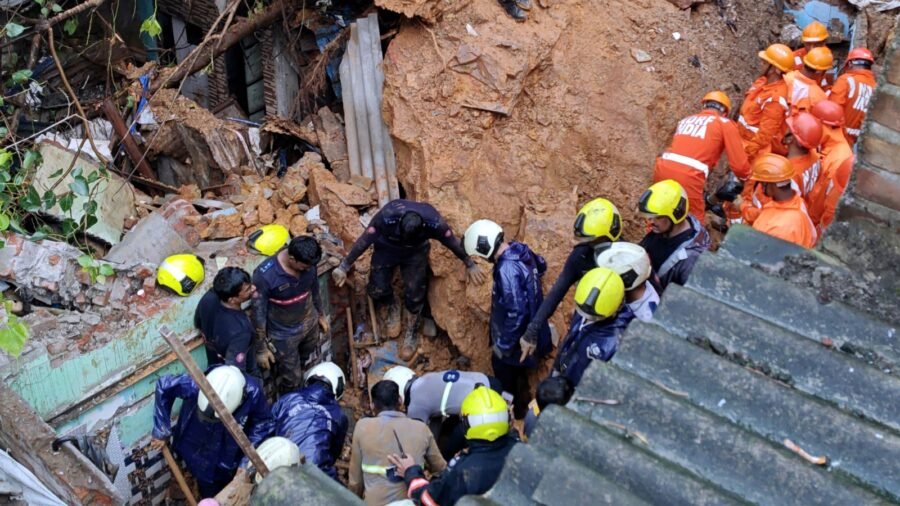
Days after a landslide in Kurla killed eight people, the Brihanmumbai Municipal Corporation (BMC) has decided to launch a drive with the Mumbai Collector’s office after the monsoon to remove illegal encroachments and structures from landslide-prone areas, BMC Commissioner Ashwini Bhide told Friday.
Speaking at ’s Idea Exchange, Bhide said the civic body will identify the most vulnerable points based on a Geological Survey of India (GSI) report and work with the Collector’s office to remove encroachments from these areas. She also said the civic body may have to consider forceful eviction in cases where residents refuse to leave after being served notices.
“Providing alternate accommodation for encroachers cannot always be possible, especially when a city has maxed out on its space and capacity. At some point of time, we will have to implement forceful eviction of illegal encroachers, by following all stipulated rules that are in place,” Bhide told the newsroom, responding to a question on the recent deaths during the Kurla landslide and the building collapse in Mankhurd, in both of which the BMC had said it had issued notices to residents to vacate citing safety concerns.
“After the monsoon gets over, we will issue notices to illegal encroachers and ask them to vacate the premises first. If required, forceful eviction will be carried out,” she said. Bhide said the BMC had already held a meeting with the Collector’s office on the proposed joint drive. Under the arrangement, the Collector’s office will issue notices to encroachers, while the BMC will deploy manpower for the removal drive.
“The GSI has submitted a report to us identifying the most vulnerable landslide-prone areas in Mumbai. In some areas, the preventive measures that they have suggested are implemented while in some they are awaiting to be implemented,” she added. She said a review of the preventive measures at vulnerable locations would also be undertaken after the monsoon.
“As per GSI’s recommendations, safety retaining walls have been constructed at some places to prevent landslides. However, these walls are not proving to be enough. Also, people living there have built toilets which expose these walls to water seepage, making them weak. Therefore, a review of these structures will be carried out post monsoon to check if they are adequate,” Bhide said.
The Collector’s office is expected to begin the eviction process immediately after the monsoon. Mumbai Collector Saurabh Katiyar told this newspaper that the process would begin with notices asking residents to vacate voluntarily, followed by an eviction drive if they refuse.
Story continues below this ad
“There is a court order that prevents eviction drives during the monsoon. There is also a set of SOPs that need to be followed in the process of encroachment removal. As a first step, we will issue them notices asking them to leave the premises voluntarily. If they fail to do so, the Collector’s office will carry out a drive following the government’s prescribed rules,” Katiyar said.
had first reported Friday that a GSI report submitted to the BMC in 2018 had classified the Kurla hillock that collapsed this week as a Class II, or highly vulnerable, zone and had warned the administration of the risk of a landslide.
At Hill No. 3 in Kurla, the GSI’s 2018 report had recommended a halt to further cutting of the slope and construction towards it, along with retaining walls with weep holes, toe drains, drainage for surface and sanitary water and other measures to reduce the risk of landslides. The report had also noted that no major drain passed through the area. Several of these measures were yet to be implemented at Hill No. 3 when the landslide occurred this week.
Bhide said providing rehabilitation to every encroacher would not always be possible and that only those living in protected structures or eligible under government housing schemes could be considered for alternate accommodation.
Story continues below this ad
“There have been incidents where, in many cases, encroachers are also unwilling to take alternate accommodation. Since most of these encroached lands are owned by the government, the BMC cannot go and evict them. Therefore, these actions need to be taken up carefully after multiple levels of deliberations,” she said.

Bombay HC Orders ₹8.14 Lakh Compensation To Parents Of Man Who Fell From Local Train In 2015
By Sohail Khan · 29 Sep