BWF World C’ships: Sport moving to plastic shuttles despite pollution concerns
Mixed doubles shuttler Marvin Seidel plays Bashminton to unwind. The toy set with oversized racquets and a crazy-ball shuttle bird ends up with wild trajectories. Not in his wildest, did he imagine that a synthetic shuttle or a hybrid might actually make its way onto a real badminton court, where he is a former European champion.
A promotional event for the experimental synthetic birds that the Badminton World Federation is looking to introduce in the future, saw Seidel toss them around for 30 odd minutes. His feedback? “It’s fine. The sound it makes is a little off compared to feather shuttles. And you have to adjust to spin because it tumbles longer,” he said after his mixed doubles loss at the Delhi Badminton World Championships, even as he anticipates them being unrolled sooner than in the next five years.
But sitting in Germany, Seidel processed the shortage of feather shuttles last summer and the increase in prices of shuttle tubes as something of an artificially created crisis. “Perhaps due to monopolies,” he ventures.
The shortages stemmed from China’s changed dietary preferences – duck to chicken, whose ripple effect saw a shortage of geese feathers and a 300% rise in shuttle costs.
Even as feather shuttles need substitutes for the sport to stay sustainable, Seidel flags a larger long-term concern. “The whole world and every sport is going green, and badminton is going plastic! I don’t see the benefit of mass plastic usage. After one use they will just be lying somewhere because plastic can’t be recycled. I think we are shooting ourselves in the foot,” he added.
The German badminton federation approved of synthetics earlier this year, and at the German Open, top players ended up playing a ‘triple format’ – a three-a-side as demonstration on the day of the semifinals.
The synthetics, still being tested, but almost inevitable in coming years, aren’t exactly widely available, which brings skepticism about them being adopted. Pitched to replace the feathers for their durability and with the geese feathers becoming scarce, the synths are raising a fundamental question – is badminton really on the path to being sustainable?
*”*”*
Story continues below this ad
Surfeit of sponsors sees A board rotations
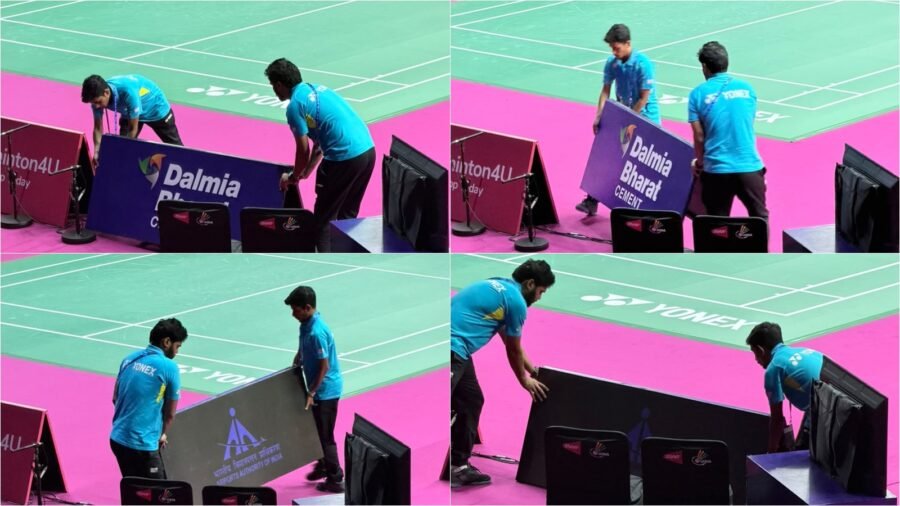
There are no digital advertising boards at Delhi’s Badminton World’s HQ and the Delhi Worlds don’t have a title sponsor. But the Badminton World Federation has invited a surfeit of secondary sponsors for their mega spectacle in India, numbering 16 at least. It also means there are limited spots on the court, with 14 boards visible on broadcast cameras at any given point. It’s why a mid-match manual switch of boards happens.
Two volunteers lift the A-board and invert the side which has two distinct names on the two sides of the triangular boards. The initial plan was to dim the lights at the 11-point mark and switch like a stage play set prop. But the organisers have refused risking electric malfunctions by turning lights off and on. “We switch the boards after every game,” BAI secretary Sanjay Mishra explained. It happens when cameras are on the mid-match parleys between coach and player, allowing volunteers to turn boards around. Badminton court aesthetic barely helps back boards register, but if you notice revolving sponsor names, there’s a rehearsed manual switch happening in this low-tech sport.



India at Asian Games 2026 Day 6, September 24: Full schedule, venue, fixtures & time
By Sohail Khan · 24 Sep