BJP says Sonia Gandhi opposed singing of full Vande Mataram, demands apology; Congress rejects charge
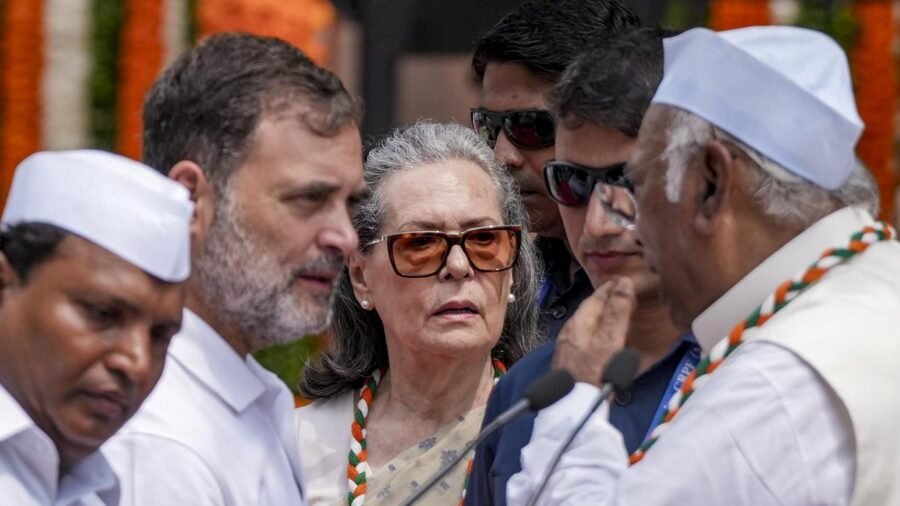
The rendition of the full six stanzas of Vande Mataram at the headquarters of the Indian National Congress triggered a controversy on Saturday (August 15, 2026) after the Congress Parliamentary Party (CPP) chairperson Sonia Gandhi was seen gesturing during the song, prompting the Bharatiya Janata Party (BJP) to allege that she had tried to stop it, while the Congress denied the charge.
Bankim Chandra's descendant seeks Sonia Gandhi's apology over 'Vande Mataram' row
At a ceremony to hoist the national flag at Indira Bhawan here, Ms. Gandhi was seen gesturing towards Congress president Mallikarjun Kharge while the national song was being sung. A Seva Dal volunteer then approached the CPP chairperson and spoke to her.
Subsequently, Ms. Gandhi and the Leader of the Opposition in the Lok Sabha Rahul Gandhi were seen having an animated discussion with Seva Dal chief B.V. Srinivas, and his predecessor Lalji Desai.
A hot mic situation purportedly revealed Mr. Gandhi was saying that the Congress was singing “our version of Vande Mataram”.
“Today, on Independence Day, when Vande Mataram was sung in its entirety in keeping with the sentiments of millions of Indians, the sight of Congress’s supreme leader Sonia Gandhi, super president Rahul Gandhi, and current president Mallikarjun Kharge conversing with one another and displaying disrespect at the Congress office at the very same time is utterly bizarre, ironic, and unfortunate,” BJP spokesperson Sudhanshu Trivedi said in a post on social media platform X.
“We condemn this conduct of the Congress party’s top leadership and expect the Congress party to apologise to the nation for it,” Mr. Trivedi said, calling it an insult to the national song.
Defending the party’s position, Congress’s communications chief Jairam Ramesh said Ms. Gandhi had been asking for a chair for Mr. Kharge. “As the Congress president was standing for a long time, Sonia ji was asking for a chair for him,” Mr. Ramesh claimed. “But today, at Indira Bhawan, the full version [of the Vande Mataram] was sung. There is no question of a controversy over it,” he added.
सोनिया गांधी को 'वंदे मातरम्' की कुछ शुरुआती पंक्तियों के बाद ही इसे लेकर असहजता होने लगी। उन्होंने गीत रोकने का संकेत दिया। राहुल गांधी भी पूरे गायन के दौरान और राष्ट्रगीत समाप्त होने के बाद तक परेशान दिखे।
यही तो कांग्रेस की पुरानी दुविधा है — गांधी परिवार को भारत की… pic.twitter.com/q68oN6HNxb— BJP (@BJP4India) August 15, 2026
Mr. Ramesh cited history to argue Rabindranath Tagore had suggested that only the first few stanzas of Vande Mataram be sung. On October 28, 1937, a meeting of the Congress Working Committee was held in Calcutta in the presence of Mahatma Gandhi, Netaji Subhas Chandra Bose, Sardar Vallabhbhai Patel, Maulana Abul Kalam Azad, Jawaharlal Nehru, Govind Ballabh Pant, and C. Rajagopalachari.
“On the advice of Gurudev Rabindranath Tagore, they decided that the initial stanzas of Vande Mataram would be sung at Congress sessions,” Mr. Ramesh said, adding that Tagore had given this advice to Nehru and Bose.
The Congress had opposed the Bill that added criminal provisions to an alleged insult while singing Vande Mataram, he added.
“This was discussed in Parliament for 16 hours. We put forward our views. I narrated the whole history around it, which the Prime Minister and the Home Minister did not know. I informed MPs of the context in which the Vande Mataram decision was taken,” Mr. Ramesh said.
The controversy assumes significance against the backdrop of guidelines issued by the Union Home Ministry in February, and reiterated in July, on the observance of the national song, and the subsequent passage of the Prevention of Insults to National Honour (Amendment) Act, 2026.
In July, Parliament passed the Prevention of Insults to National Honour (Amendment) Bill, 2026, making an attempt to stop or prevent the singing or playing of the national song an offence. The Bill was passed by a voice vote in the Lok Sabha on July 30, 2026, a day after it was approved by the Rajya Sabha. The law also accords Vande Mataram a status on par with the national anthem, Jana Gana Mana.
Earlier, the Ministry of Home Affairs issued detailed guidelines on the observance of Vande Mataram, directing that all six stanzas of the official version be rendered first, whenever the national song and national anthem are performed together.
The guidelines say the full six-stanza version is to be sung or played on key state occasions, including the arrival of the President, the unfurling of the national flag and addresses by Governors, civil investitures, on the arrival and departure of the President and Governors at formal State functions, and at other functions organised by the government.
Vande Mataram is also to be played immediately before and after the President’s address to the nation, and when the national flag is brought on parade. The Ministry has further directed that people present at assemblies where the national song is performed stand to attention.



Changing climate demands stronger water monitoring, early warnings: CR Patil
By Sohail Khan · 22 Sep