Before building higher, Delhi must strengthen the city beneath its buildings
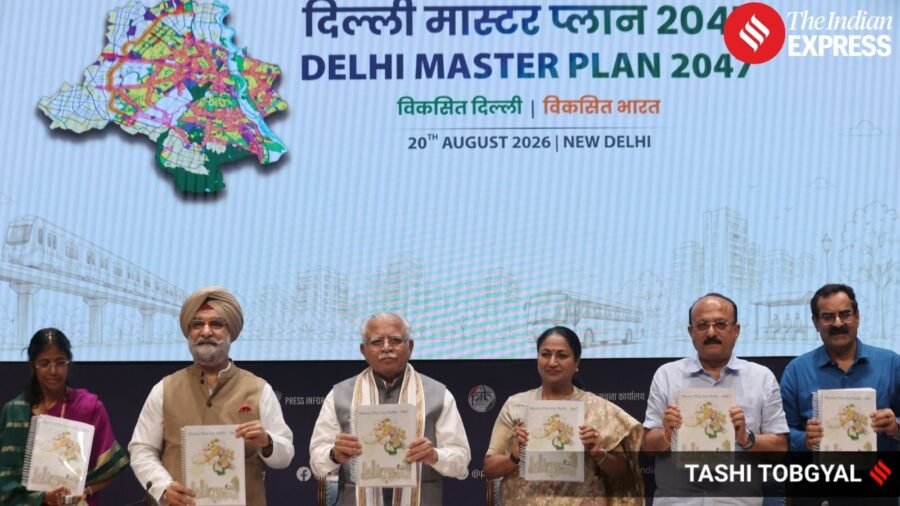
The Master Plan for Delhi 2047 (MPD-2047) sets out a new approach to how the city should grow over the next two decades. It seeks to accommodate 3.2 crore people and provide 40 lakh additional homes, much of this through redevelopment of existing areas and higher-density construction around public transport. Notably, it reduces the minimum area needed to redevelop housing complexes from 40,000 sq m to 3,000 sq m. This reduces the redevelopment threshold from about 10 acres to less than one acre, enabling regeneration at a much smaller and more manageable scale — from the size of a large housing colony to that of a small apartment complex. I support it.
Regeneration schemes in unauthorised colonies may receive a floor area ratio (FAR) of 350, while the High-Density Corridor along Urban Extension Road-II (UER-II) allows a FAR of 400. Both changes are necessary because Delhi has limited land and a growing population. Redevelopment cannot be based indefinitely on outward expansion. The proposals for affordable and rental housing, a Unified Metropolitan Transport Authority, unified parking management, and designated areas for 24-hour activity are also forward-looking.
Advertisement
Compact and mixed-use development along UER-II — a 75-km western arc from Alipur on National Highway 44 (NH-44) to Mahipalpur on National Highway 48 (NH-48), passing through Bawana, Rohini, Mundka, Bakkarwala (near Nangloi), Najafgarh and Dwarka — could expand housing and bring people closer to employment. But more floor space means more residents, vehicles, sewage, waste, and greater demand for water and electricity. Unless this is accounted for, new people will move to the already congested parts of Delhi in search of jobs, worsening the congestion. Planning must consider not just plot capacity but also the hinterland’s ability to support more livelihoods and visitors.
Years in administration taught me that constructing buildings is the easier part, particularly when private developers are involved. The harder task is expanding trunk water mains, arterial sewers, pumping stations, stormwater drains, substations, cables and public roads outside the colony gates. Gurugram provides an apt warning. Golf Course Road, lined by some of India’s most expensive gated communities, has repeatedly suffered waterlogging, showing that excellent private construction cannot compensate for inadequate public infrastructure.
MPD-2047 describes its approach as “infrastructure-led”, but its own water projections reveal considerable uncertainty. It estimates potable-water demand of 1,600 million gallons a day (MGD) by 2047, against the present availability of about 1,000 MGD. The proposed augmentation of 401 MGD would still leave a gap of about 199 MGD. More importantly, 275 MGD is expected from the Renukaji, Lakhwar and Kishau projects, which the Plan itself calls “highly tentative” and dependent on interstate cooperation.
Advertisement
On drainage, too, the Plan isn’t clear. At one place, it says the Delhi Drainage Master Plan is under preparation; elsewhere, it calls for implementation of the Irrigation and Flood Control Department’s Drainage Master Plan. Before large-scale densification begins, Delhi needs to know which plan applies and whether it reflects the new density projections.
While the new Master Plan refers to upgrading physical and social infrastructure, it does not specify that essential infrastructure must precede development. Accepted planning practice requires the opposite: Before additional FAR is sanctioned, the capacity and land requirements for water, sewerage, drainage, power, roads, transport and public facilities should be assessed for the entire area under development. MPD-2047 should have made higher density conditional on these requirements being secured in advance.
More than 20 years ago, as Delhi’s chief secretary, I attended Raj Niwas meetings where DDA officers discussed issues related to the previous Master Plan. The departments handling water, sewerage, drainage and roads ran in their own worlds, oblivious to the DDA’s Master Plan. MPD-2047 has involved wider consultation, including with the principal implementing agencies. But consultation is not coordination. These bodies must agree on capacity additions, budgets, sequencing and timelines with one authority answerable for ensuring that the works are completed before high-density development begins.
The plan prioritises the regeneration of unauthorised colonies. That is a necessary, and humane, approach: Residents cannot indefinitely be denied safe buildings, sewers, drains and public facilities. But many existing structures predate effective structural, fire and seismic safeguards. Higher FAR must, therefore, be accompanied by credible safety audits, emergency access, open spaces and upgraded networks.
Preventing new unauthorised colonies is another urgent need. The plan proposes GIS mapping, remote sensing and drone surveys to detect illegal development, and suggests disincentives against it. But detection is not enforcement. The Plan does not clearly identify which authority must act on the first alert, within what period, or what consequences follow when an illegal subdivision grows because of collusion or negligence. Unauthorised colonisation has proliferated over the last 60 years. Without a clear chain of responsibility, prevention in name could again lead to recurring amnesty when pressures mount.
MPD-2047 recognises the unequal distribution of Delhi’s green spaces and refers to green-blue infrastructure, parks, walking and cycling. Yet, as density rises, it sets no clear standard for access to usable neighbourhood green space. Parking reforms will achieve little if road parking remains free and pavements remain clogged. The Plan specifies how much more can be built, but is less precise about the public infrastructure and spaces that must accompany that growth.
How, then, should MPD-2047 be rated? It is strong in recognising Delhi’s need for redevelopment, additional housing, public-transport-led growth and new economic activity. It is promising on rental housing, integrated mobility and regeneration. It is aspirational on parks, walking, cycling and public spaces, tentative on water and drainage, and incomplete on sequencing, enforcement and direct accountability.
This is not an argument against builders, migrants, high-rise housing or the improvement of unauthorised colonies. It is an argument for implementing the Plan in the right order. Before building higher, Delhi must first strengthen the city beneath its buildings.
The writer is former chief secretary, Delhi and former secretary, Ministry of Health

Letters to The Editor — September 26, 2026
By Sohail Khan · 25 Sep
Revisiting India’s nuclear doctrine without revising it
By Sohail Khan · 25 Sep
The case for accountable lottery regulation in India
By Sohail Khan · 25 Sep