As students protest in law varsities, Justice Bhuyan calls for appointment of SC judges from legal academia
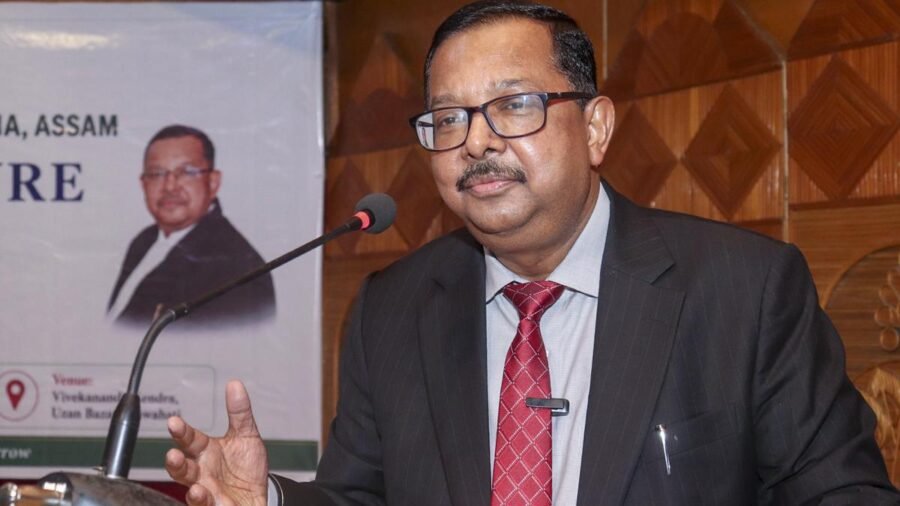
As student bodies across premier national universities object to Chief Justice of India Surya Kant’s remarks and refuse to have him over for their convocations, Supreme Court judge Justice Ujjal Bhuyan on Sunday (August 30, 2026) pushed for the activation of Presidential power to directly appoint ‘distinguished jurists’,including legal academicians, as judges in the top court of the country.
“While our Constitution has a provision for appointment of a jurist as a judge of the Supreme Court, no jurist has been appointed so far to the Supreme Court though the Constitution has completed more than 76 years,” Justice Bhuyan pointed out at the 13th convocation of the 2026 LLM batch of the National Law University, Delhi.
Justice Bhuyan said that as important as the right to question was the tolerance to disagreement.
“Just as important as the freedom to question: it is the ability to tolerate disagreement or a different point of view. A democratic society cannot be built on the edifice that everyone will think alike,” Justice Bhuyan said.
The comments from the Supreme Court judgefollow a recent debacle by the Bar Council of India, which ordered State Bar Councils to bar the professional enrolment of the 2026 batch of NALSAR students for objecting to have CJI Kant over as the chief guest for their convocation over his oral comments in court using terms such as ‘cockroach’ and ‘parasites’. The BCI had to retract the directive following public pressure.
“Tolerance is not merely a matter of personal courtesy. It is a constitutional value. A democracy becomes meaningful not when everyone speaks the same language of thought, but when different voices can co-exist, be heard and be treated with dignity,” Justice Bhuyan said.
The Judge said the maturity of a democracy was reflected not merely in how it responded to opinions that were difficult, unpopular or inconvenient. The courage to voice unpopular opinions began at universities, Justice Bhuyan said.
He said the 76-year reluctance to activate Article 124(3) for appointment of legal academics as Supreme Court judges in the category of ‘distinguished jurists’ may have been either due to the feeling that there was not enough “depth in the Indian academia” or because the provision was simply not seriously taken.
As a result, brilliant minds, men and women with legal scholarship, who could have significantly contributed on the Bench missed the opportunity to serve as judges of the Supreme Court.
Justice Bhuyan dismissed the oft-repeated argument that legal academics and scholars lack the practical experience that serve judges.
“But this is a very shallow objection. Supreme Court is not only the highest adjudicatory body but it is the moral, legal and constitutional conscience keeper of the nation. It is above technicalities. The reason for having this provision of distinguished jurist in Article 124(3) is to diversify the Bench with talented judges,” he said.
In India, the Judge said, the term ‘jurist’ was being applied very loosely.
“A lawyer or a judge of repute is often described as a jurist. Certainly, a lawyer and a judge can be a jurist, and there are many such instances, but in the context of Article 124(3), it extends beyond the above two categories. A person who is skilled in law or knowledgeable in the field of law would be qualified to be termed as a ‘jurist’,” the Supreme Court judge said.
A ‘distinguished jurist’ could be a great value addition to the Bench. By his or her scholarship, he or she can make a visible contribution to the decision-making process at the top level. Participation of renowned legal academia and scholars would have a defining impact on the judicial functioning of the Supreme Court, Justice Bhuyan said.

Behind Ujjain clash, crowd ‘misguided’ by AI videos showing entire mosque being razed
By Sohail Khan · 29 Sep