Ankara’s Bet, And Why India Should Make It Costly
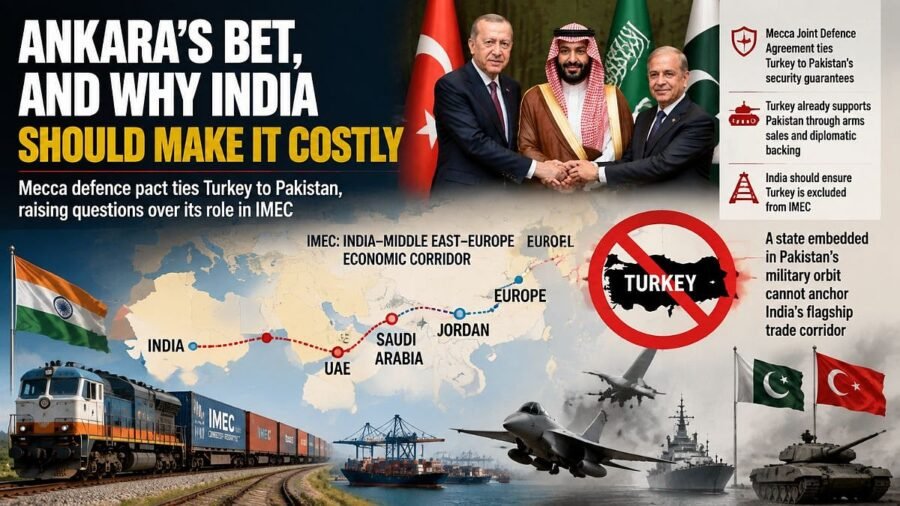
Ankara's Bet, And Why India Should Make It Costly
Turkey’s defence alignment with Pakistan should prompt India to oppose Ankara’s involvement in IMEC, with the Mecca pact offering New Delhi leverage to push for the corridor’s original route. Security, financing and infrastructure concerns also cloud possible alternative routes through Turkey and Syria.

The article argues that Turkey's growing defence alignment with Pakistan should prompt New Delhi to reconsider Ankara's role in the proposed trade corridor | AI Generated Representational Image
Turkey meets two separate conditions that give India grounds to demand its exclusion from IMEC. First, the newly signed Mecca Joint Defence Agreement formally ties Ankara to Pakistan's security guarantees. Second, and independently of the pact, Turkey has already shown through arms sales and diplomatic backing that it sides against India in any subcontinental conflict. The Mecca agreement, then, is not a threat to India so much as an opening — a moment for New Delhi to insist that a state so embedded in Pakistan's military orbit cannot also profit from India's flagship trade corridor.
Mecca Pact's Strategic Context
Little open jubilation greeted the Mecca Joint Defence Agreement in Ankara, Riyadh or Islamabad; Western capitals registered little more than polite interest. The pact is deliberately elastic, vague both in the depth of its security guarantees and in the identity of any shared adversary.
Washington has grown tired of underwriting the security of regimes that have repeatedly failed to build credible fighting forces. The poor showing of Saudi pilots in Riyadh’s early clashes with the Houthis still lingers in American institutional memory. “Burden-sharing” has become the polite term for simple American exhaustion. Netanyahu’s Israel long ago abandoned hopes of drawing the kingdom into the Abraham Accords. The United Arab Emirates, having watched Riyadh spend the past half-decade trying to copy Emirati economic success—much as Abu Dhabi once copied Singapore—makes little effort to hide its schadenfreude at the Saudis’ stumbles. Tehran, for its part, has signalled openly that this new trilateral grouping poses no serious threat, while the Houthis have made plain that pressure on Saudi borders continues unabated.
`;
And India? New Delhi harbours no illusion that Saudi Arabia is an adversary. It simply recognises that Riyadh has been obliged to settle for second-tier Pakistani protection because America’s gold-standard defence umbrella no longer extends to risking soldiers or exhausting dwindling stocks of precision munitions on behalf of Gulf monarchies.
Turkey's Growing Role
Yet, the wider geopolitical arithmetic remains troubling for Indian planners. In any future conflict with Pakistan, Beijing will almost certainly supply Islamabad with high-grade intelligence, while Ankara provides a steady flow of affordable stealth corvettes, cheap uncrewed systems and, in time perhaps, operational KAAN fighter jets. Western capitals share India’s concerns about China’s rise readily enough; Turkey’s quieter disruptive role across the subcontinent proves far harder to impress upon Ankara’s NATO allies.
This newly formalised trilateral alignment does, however, present New Delhi with a clear opportunity. By explicitly tying Pakistani security guarantees to Turkish defence exports, the Mecca pact gives India the leverage to insist that a state so deeply embedded in Islamabad’s military orbit can never serve as a reliable anchor for the India-Middle East-Europe Economic Corridor (IMEC).
India's IMEC Leverage
A clear message from New Delhi to IMEC’s other participants—whether through public diplomacy or quieter channels—that the corridor should adhere to its original route and avoid Turkey and its areas of influence in Syria would help impose clearer boundaries on a project still marked by institutional drift.
Despite the apparent political miracle of the Trump administration adopting an initiative conceived under Biden, the corridor remains largely speculative. Cross-border freight and high-speed digital links fit neatly with Riyadh’s Vision 2030 diversification plans, yet Saudi Arabia did not join the project at its inception. Washington continues to lead the concept with officials of insufficient seniority. European partners, such as France and Italy, have been pleasantly proactive, and Germany has shown genuine interest in the proposed green hydrogen pipeline, but localised momentum is not yet enough. The private sector’s willingness to absorb the project’s vast capital costs remains unproven. Clarity is still lacking on whether sufficient volume exists on the East-West axis to justify a mid-tier route faster than the Suez Canal yet cheaper than air freight. A legal arbitration mechanism for state and private partners has yet to be drafted. Even Israel, a primary beneficiary that already possesses an active rail line from the Adani-owned port in Haifa almost to the Jordanian border, has not yet allocated public funds to complete the final missing stretch of less than ten miles.
Questions Over Turkey-Syria Route
Even without any explicit Indian ultimatum, a fundamental question mark hangs over the viability of any alternative route through Turkey and Syria. The Syrian president’s swift transition from guerrilla fatigues to a tailored European suit, together with his newly moderate rhetoric, risks creating the illusion that Syria possesses a functioning state apparatus capable of safeguarding a railway carrying high-value supplies bound for Europe. In truth, even Bihar at its lawless 1990s nadir, when we as young backpackers feared the short journey from Gaya to Bodh Gaya for dread of bandits, was not goonda raj on the scale of present-day Syria.
An assertive, early intervention by New Delhi to exclude Turkey and its satellites permanently would, therefore, set essential parameters long before the project is ready for practical implementation. If there is any redeeming feature to the currently unattractive political honeymoon between Donald Trump and Recep Tayyip Erdoğan, it is that Ankara is effectively barred from pivoting towards a Chinese-backed alternative. That leaves India with useful strategic leverage to shape the boundaries of Eurasian connectivity on terms that serve its own interests.
Trade Security To Shape IMEC
Ultimate leadership of IMEC will not be decided by grand multilateral communiqués or speculative maps drawn in western capitals, but by the cold arithmetic of trade security. In spite of Turkey's greater democracy and traditionally realistic foreign policy, compared to Iran's obsession with Israel and the United States—lacking any clear realpolitik logic—it is still not clear that an IMEC route via Turkey would be better than the INSTC, despite the sanctions currently crippling the Iranian route.
If New Delhi acts decisively, the Mecca pact may be remembered not as a milestone in Gulf security but as the moment India drew a firm line on its western horizon, proving that those who arm its rivals cannot expect to profit from its trade routes.
Lev Aran is an Israel-based freelance journalist. A former coordinator of the Israel-India Parliamentary Friendship League.

Add As a
Trusted Source