AI optimism fades among youth, new research reveals
There is a disconnect between how tech companies pitch artificial intelligence and tout its surge in usage and how people, especially young adults, are responding to AI. At least, the Pew Research Center’s latest report, published Tuesday, suggests.
In a recent survey conducted in the US among young adults under 30, a majority said they are more concerned than excited about AI. In fact, Pew found that 55 per cent of adults under 30 said they feel “more concerned” than “excited,” a sharp increase from just two years ago, when 39 per cent said they felt more concerned than excited about AI. Pew surveyed 3,488 US adults from June 22 to June 28, 2026.
Across all age groups, 52 per cent of US adults said they feel more concerned than excited about AI, up from 37 per cent in 2021. Roughly one in 10 said they are more excited about AI being embedded in daily life, while a third said they feel equally concerned and excited. That sentiment is broadly consistent across other age groups: 51 per cent of adults ages 30 to 49 feel more concerned, as do 47 per cent of those ages 50 to 64 and 59 per cent of those 65 and older.
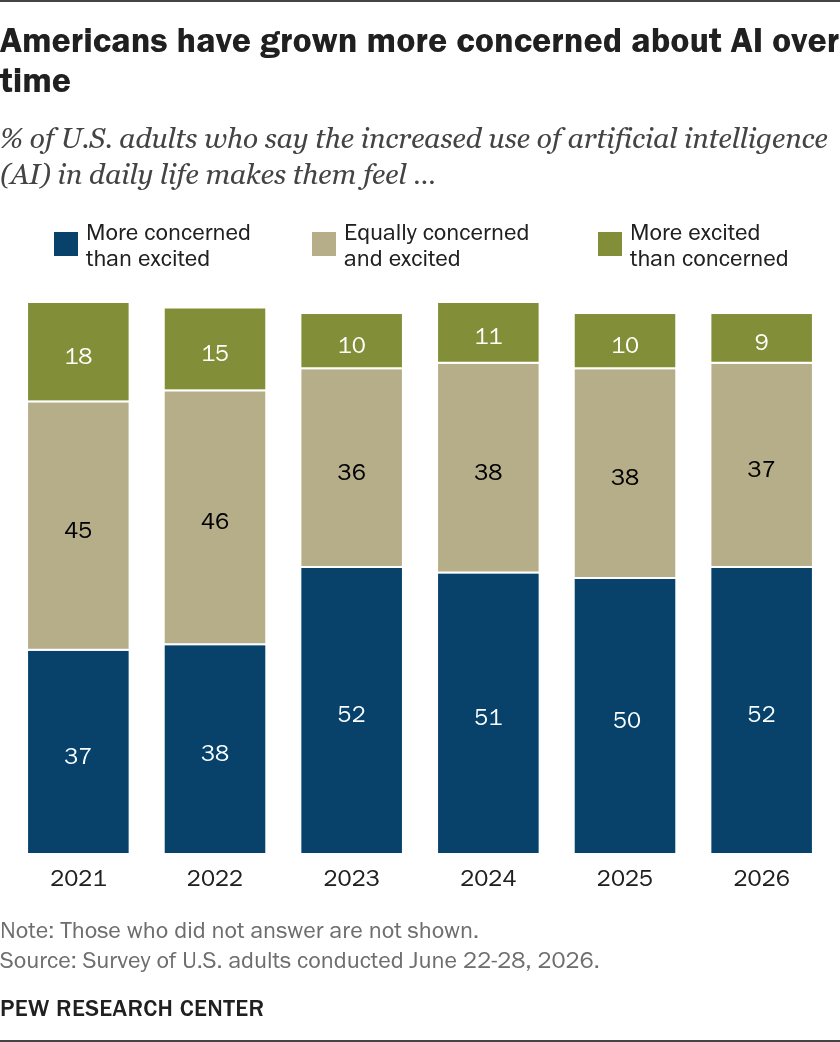 More Americans also believe AI will take people’s jobs over the next two decades.
More Americans also believe AI will take people’s jobs over the next two decades, according to the Pew survey. It found that 71 per cent of respondents believe AI will lead to fewer job opportunities, up from 64 per cent in 2024. The belief that AI will lead to fewer jobs has surged more among American adults under 30, rising from 61 per cent in 2024 to 73 per cent this year. The age group 65 and above is the least likely to think AI will reduce jobs, with 63 per cent saying so, a five-point increase from 2024.
Around the globe, sentiment toward AI is becoming increasingly negative, and the backlash is likely to grow as more people worry that it will take away their jobs, drive up electricity rates, hurt the environment, and make everything more expensive. That being said, AI executives remain unfazed by the backlash and continue to argue that businesses and consumers will benefit from the productivity gains AI will bring.
Companies such as Nvidia, Google, Meta, Amazon, Microsoft, Oracle, and others have collectively spent more than $1 trillion on AI projects and infrastructure in just three years, with much more spending expected. Demand for Nvidia’s chips and services has driven the company’s market value up fivefold in three years.
Although the billions of dollars being spent on AI demonstrate the faith these tech companies have in the technology and its potential, they also highlight the risks of a so-called “circular” financing system at the core of the AI ecosystem. Circular financing works this way: One company pays another for a product or deal, invests in that company, or provides it with a loan or lease. The second company then purchases the first company’s products or services. However, the question is how long tech companies can sustain this circular financing model. If one company falls, would others fall with it?
Story continues below this ad
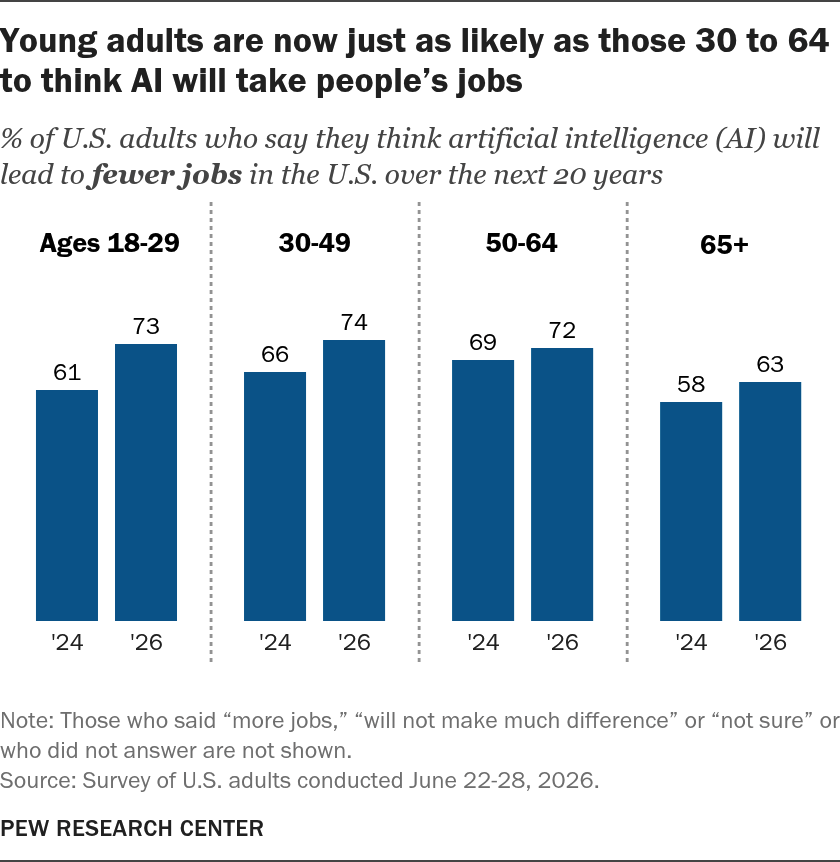 Excitement about AI has dropped among all age groups since 2021, according to the Pew survey.
But as spending on AI and data center buildouts increases, pressure is mounting on tech companies from shareholders to generate profits as quickly as possible. There is also growing pressure from policymakers to share the wealth with others.
While tech companies claim that AI is creating more jobs, the question remains: Who will benefit from the AI boom? The reality, however, is more complicated. Traditional jobs and degrees such as BA and MA are becoming less relevant, while demand for AI engineers is increasing. In fact, AI engineers have the bargaining power to negotiate higher compensation packages, and companies are willing to pay them. These high salaries, which often include equity and RSUs, are uncommon in other sectors, making AI engineers the most in-demand and the highest-paid workforce.
A LinkedIn survey published this week by the Microsoft-owned professional networking platform revealed the 12 fastest-growing AI jobs, based on an analysis of the platform’s data, including the gender, education, and age of people who were hired. The study focused on AI jobs defined as “AI engineering and technology-building roles.” The survey revealed that AI jobs are on the rise and is creating the fastest-growing and highest-paying opportunities for millennials and Gen-Z. In the US, AI job postings have roughly doubled since 2023, and the typical posting lists about $177,000 in compensation, compared with $80,000 for a non-AI role.

What is a kill switch, and why is it hard to build one for AI systems?
By Sohail Khan · 20 Sep
A smartwatch should fit your routine, not interrupt it. These five models go the extra mile
By Sohail Khan · 20 Sep
Nike Alphafly 4: 5 things (including the science) behind new marathon shoes
By Sohail Khan · 20 Sep